November 2, 2022

Batikful week in Jakarta

Photo from Museum Batik's instagram

Me and Mbak Liesna posing at Galeri Batik
at Museum Tekstil in Jakarta


Sitting in a Roti’O were the one employee tries between every customer to make swirls of cinnamon on bread buns. Waiting for my time to board. Left so early, was so worried, so end up with a lot of extra time.

My week in Jakarta, although extended because of the visa process, was a useful & Batikful week. 
Arriving in the middle of the night on Monday, the next day headed first to Erasmushuis to report on my progress. Lucky director Yolande had time to meet me and was so great to tell in short about the first, very good, responses of the pembatiks & organisations I hope to work with. Also could share my worries, because it is not going well with Batik. But even more reason to make this exhibition next year!
In the afternoon I went to Bu Jennifer to pick up my suitcase & restock of Batiks. It was good to report here too of my travels and to think together on what could help who. 

'Tiga Negeri' inspired coffee and tea set by Wastraloka
at INACRAFT in Jakarta

On Wednesday after a morning starting up the visa process and being stuck in malls, got a WA from Bu Jennifer INACRAFT started. I was around the corner, so spend the afternoon there. 
Inacraft is the “Biggest and Most Complete exhibition of gifts and Housewares” with this year theme ‘From Smart Village to Global Market’. Sooo a lot of Batik, other textiles and crafts filled the huge venue. Happy to see so many stalls selling Batik after seeing the empty venue in Pekalongan and seeing so many visitors (with shopping bags) on the first day. 
Sad I was not able to go to Yogya because of the extra days in Jakarta, I was so happy finding Wastraloka had a huge stall at Inacraft. Loving all their hand-painted Batik stuff, I finally went for a small ‘Tiga Negeri’ inspired kopi set. Cannot wait to share a ‘kopi tubruk’ together with Koen when I return home.

Batiks with Buketan and Art Nouveau borders 
from Pak Hartono's collection


On Thursday I gave the talk I give in Singapore for Pak Hartono. When I told him last time about ‘Batik Belanda’ and how it is actually the name for imitation, he ask me to come and tell more. The easiest way to explain I thought was with my talk. Pak Hartono’s assistant translated were needed and we had some great in-depth discussion on it. It was received really good. And again I was asked when my book will be published. An re-occurring question, although a book on my research seems fun, and mostly a lot of work, my focus for now is on talks & articles. They give me the room to dive into smaller, micro histories, without having to explain, or know, all. 
The rest of the afternoon we spend looking at Pak Hartono’s extensive Batik collection with an, how he know nicely put it “possibly European influence”. Feeling lucky to get to see so many signed Batiks by the entrepreneurs I hope to learn about more in the near future.


An artwork with the title 'Perjalanan Batik Nusantara /The Journey of Batik Nusantara'

'From Kawung to Parang, from Phoenix to Sawunggaling' at Museum Batik


On Friday I got to go to the Batik Museum, the new one in Taman Mini. Since the surprising appearance of this museum ~ nobody, especially the other batik/textile museum knew anything about it ~ it was on my wishlist to visit. How many time I said during the Bahasa Indonesia lessons “Saya mau pergi ke Museum Batik yang baru”. 
Mas Ardi of Museum Tekstil was so kind to arrange it. It just had its soft opening, but is not officially open yet, so an unique opportunity for this batikreporter. The museum is pretty big, the exhibition makes a bend and slight tilt, maybe not the best for everyone. The collection is growing, mostly made from donations and had improved since the start in 2021. Welcomed by Mbak Arum and Mbak Aci, we got a full tour of what was on display, what they hope to add or examine further. Everyone working at the museum is new to Batik, so most info comes from what the donators tell them about the pieces. So mistakes are plenty to be found in the texts. At the display on ‘Batik Belanda’, I explained the name was actually not used for Batiks with an European influence, but for Dutch imitations. Mas Arum said: “Oh, like Vlisco”. I was like, yessss! They said they will change it, but we first will plan an online event in which I can explain more. 
The museum wants to improve quickly. There is also a big wish to collaborate more and continue field-research. It was great to see new produced batiks, examples of the process and videos made together with batikmakers like Kidang Mas. The museum want to play a role in the improvement of Batik. To get in more sustainable and keep it for future generations, as an active craft! Outside the planted natural dye plants and they have a machine to filter the water after dyeing. Their hope is to do all workshops with natural dye. The temporary exhibition, which will be the first exhibition when opened fully, was on Warna Alami, natural dye, but most batiks shown were actually synthetic dyed. Addressing one, a pretend ‘Cinderella’ batik, it was received with shock. I showed the actual old one and it was directly clear this was a newer, synthetic version. 
It was great to have a preview of the museum, very happy to connect and hope we can work together in the near future.

Pretend 'Cinderella' (?) from the Museum Batik collection

Batik with 'Cinderella' motif from the Wereldmuseum collection
currently on display in Rotterdam (NL)

With Mbak Arum and Mbak Aci at Museum Batik
Photo from Museum Batik's instagram

Batik Nitik exhibition at Museum Tekstil

Saturday I spend the day with my batiksister Liesna Subianto and her husband. I dressed for the occasion in the kebaya and belt she gifted me from Galeri Liesna and paired it with the Utama pants by Baju by Oniatta. When I come to Mbak Liesna’s house she changed to match more with my outfit.
We went to two exhibitions, first Batik Nitik at Museum Tekstil. We started in Galeri Batik, always nice to see the more recently made batiks on loan from Yayasan Batik Indonesia. Many from 2000’s, must have been a good batik year. 
We took a break in the garden. The buildings of Museum Tekstil are so interesting and huge. The gallery looks like a smaller European house from beginning of the 20th century. The main exhibition space is a huge building with a roof that mimics the Javanese traditional house while the white pillared entrance seems to be neoclassical inspired. According to the information plaque in front it was orginally build as the home of a frenchman, but nobody seems to know who this was…After our break we visited the main exhibition on ‘Batik Nitik’. Although I love me some Nitik, it gets a bit boring when it fills the space like this…

'Among the Birches’ by Aleksandra Herisz
at Museum National in Jakarta

Detail in ‘Collapse‘ by Iwona Bolinska-Walendzik
at Museum National in Jakarta
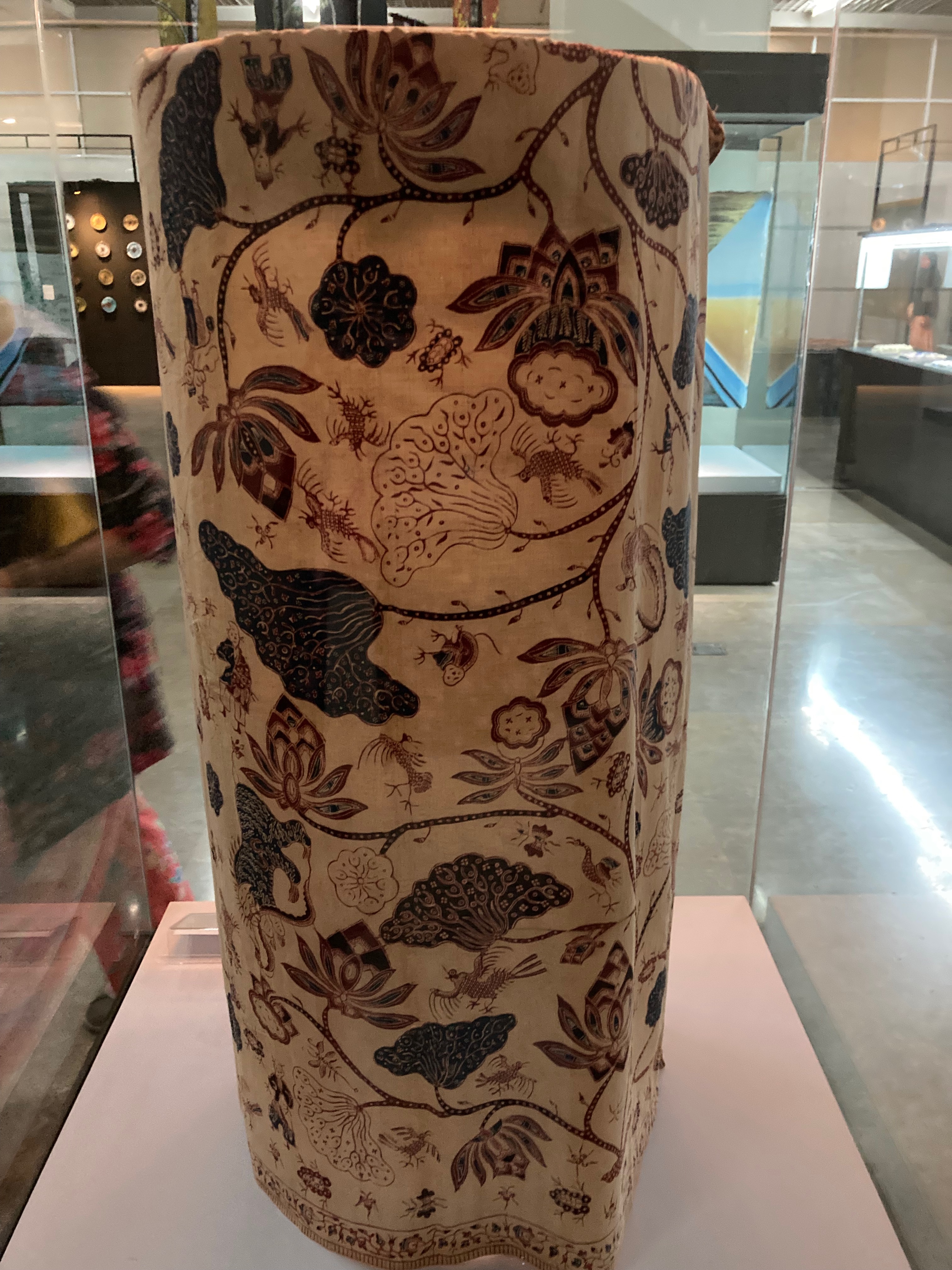
North-coast batiks from Museum National collection

North-coast batiks from Museum National collection

North-coast batiks from Museum National collection

Our second stop was at Museum Nasional for ‘Pola, The Exibition of Polish Contemporary Textile Art and Batik’. Another tip I got, and it was such a lovely, nicely set-up, a bit dark exhibition with great works by Polish artist of which many used Batik. It was the last weekend, so unfortunatly you cannot see it anymore, but share some highlights here. There were a couple of old batiks from the collection on display. Which is great, since you hardly get to see any from their, allegedly, rich batik collection. One of the modern works reminded me of stained glass titled ‘Collapse‘ by Iwona Bolinska-Walendzik. My favorite was titled ‘Among the Birches’ by Aleksandra Herisz. Beautifully installed and just so stunning. The whole exhibition gave me good inspiration on how to showcase the batiks at Erasmushuis next year!
Of course we had to see the textiles in the main exhibition of the Museum Nasional. I finally got to see the batik that is thought to be made by Raden Adjeng Kartini herself. I tried to see it before, but it was in storage before. I know it well from images from books and online searches, still it was surprising. It is indeed very European, with cornflowers and butterflies yet in traditional sogan colours…The batik doesn’t seem to give any hints on the maker, was it Kartini or maybe there is more to the story to uncover.

Detail of the batik at Museum National said to be made by Raden Adjeng Kartini

The legend of Nyi Roro Kidul
at Museum Bahari

On Sunday I was invited by Miss Ari to visit her Museum Bahari. In 2019 Miss Ari was the director of Museum Tekstil, although her love for textile is still as big, she enjoys the challenge this museum brings her.
In the morning the documentary ‘Repdeman’ was screened. The museum has a temporary exhibitions on disaster and this documentary on the tsunami of 2010 fits sadly very well. 
After the screening both the filmmaker & producer shared on the process, 4 months filming on the islands and 1,5 year to edit, and answered questions.


Got a tour through the museum which is located in a historical building which was a long time ago a VOC storage for spices. The museum shares this history, but also Maritime history of Indonesia with boats from different cultures. It has upstairs a display with creepy dolls dressed aa historical figures who were important for Indonesia. A display that is planned to be updated soon from what I heard. 
The Museum Bahari was world news, or big news in the Netherlands, when a large part was destroyed in a fire. The part is rebuild, keeping with the old structure and shows a small display on the fire in which 40% of their, partly on loan, collection was burned too.
 Outside Miss Ari opened a small spice garden. At Museum Tekstil she made a natural dye garden. I joked her next position should bring her to the botanical garden!
It was nice to catch up with Miss Ari and will great to see how the very Maritime history of textiles can be shared in the museum in the near future.

Shops in Pasar Baru

First catalog book of Museum Tekstil

My last day in Jakarta I spend researching. First I headed to Pasar Baru, the street where back in the day sellers sold ‘Batik Blanda’, imitations from Europe. Nowadays still many shops sell textiles and many sell fake printed ones with a Batik motif. The street had some remaining old Chinese shops and roofs, mostly covered up, but exciting to see these hints of history creeping through.
After my walk around, I headed to Museum Tekstil. If I want to make an exhibition there, I need to know what their collection actually is. A recent donation will make their collection a lot bigger, so I went through a pile of catalog books for a first impression. Next step will be finding out what other interesting batiks are kept since it is partly documented in an Excel with hardly any info and partly in handwritten notebooks with much more information. But great to spend the afternoon seeing the paperwork and getting ideas, many ideas!

After going through the new collection books

Almost ready to board. Will go to Bali, a short break to spend with my dear friend Barbara, which will certainly include textile adventures, but first a must needed holiday!

**Posting this while in Bali

October 25, 2022

Pulang ke Lasem

Me and Ibu Ramini showing one of her latest batik designs with pembatiks on it

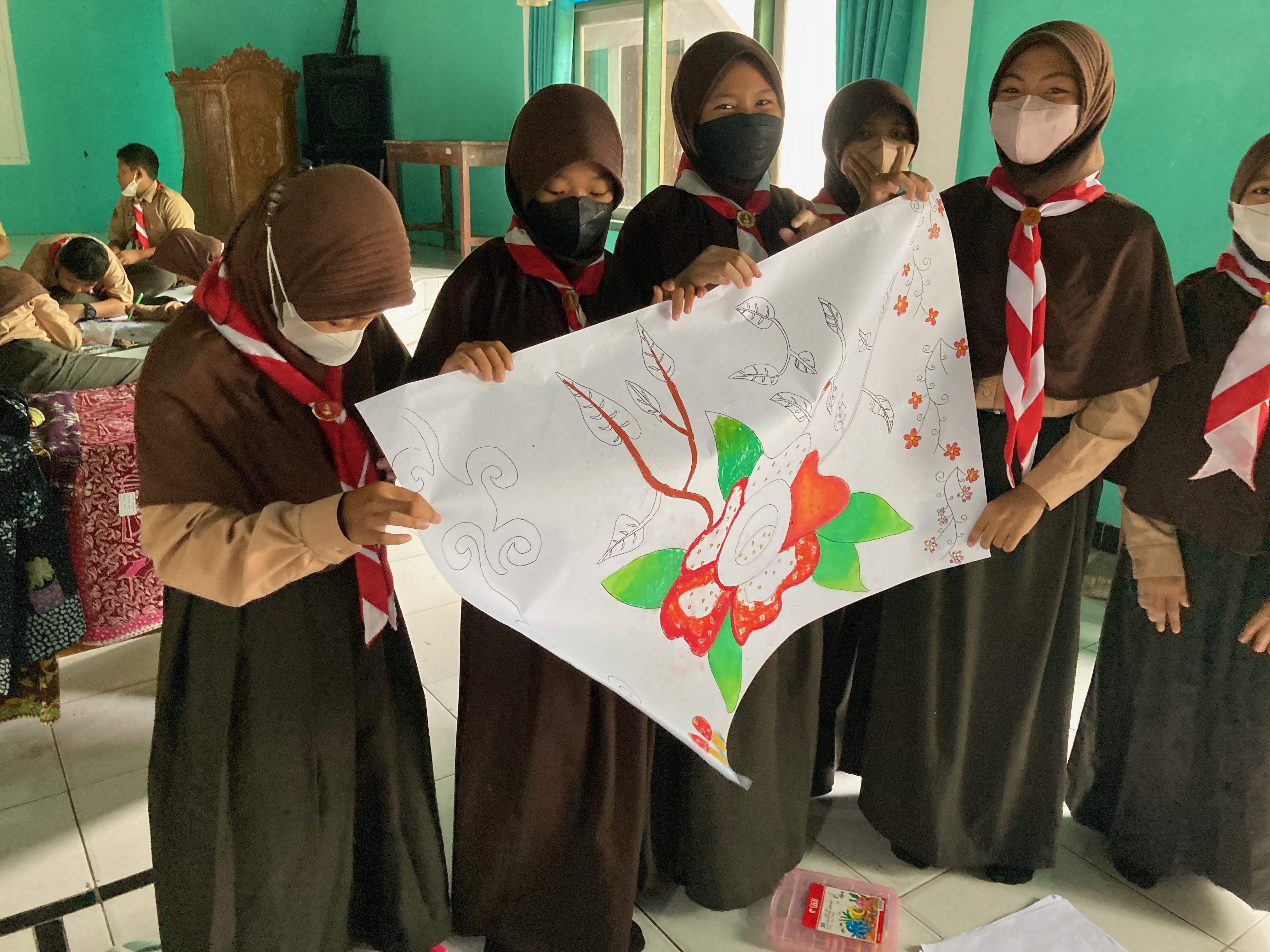
Students showing their paper batik design made during my workshop at their school

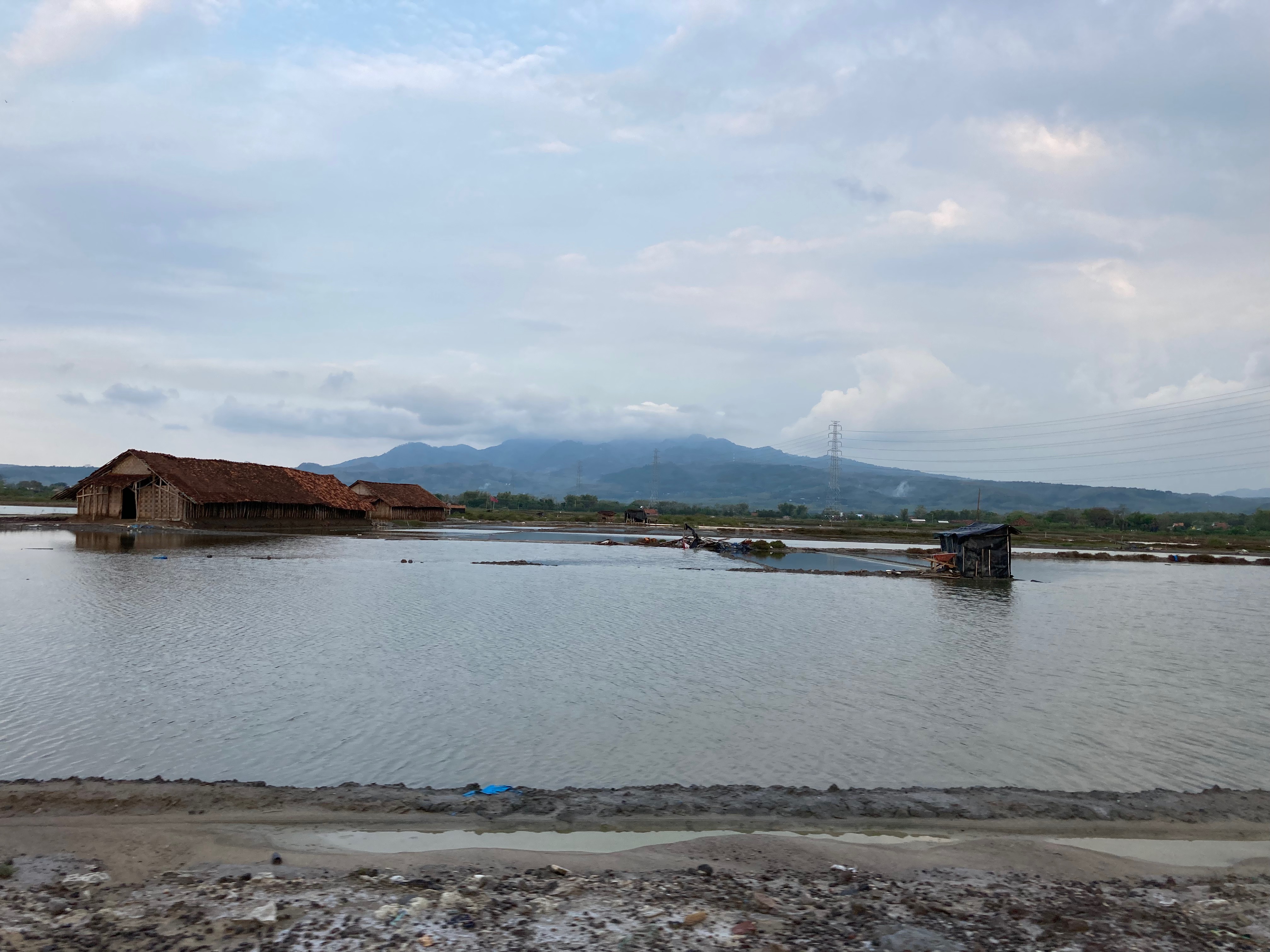
The view on the way to the beach


At the train station of Semarang while writing this. The chaos of traveling here. The bus back was much more relax than the one who brought me to Lasem. I can never get used to the swarm of men who get in your face the moment you get out a train, bus or plane. “Miss, sendiri?”, Are you alone/by yourself?… 
Anyway, traveling back to Jakarta after an amazing week in Lasem and the region Rembang. To keep the tradition going, I traveled to Lasem on 17 October, like I did in 2009, in 2016 and in 2019. This time I arrived pretty late, since the plan with travel (by car who also drops of packages) turned out to be a too long travel, but I already booked my train ticket to arrive pretty late. I enjoyed the view I had from the train & bus until it got dark.
At the busstop, I got picked up by Mas Pop. I only met Mas Pop for the first time last time, when he invited me to give a talk at Rumah Merah.
With my bags, I jumped on the back of his scooter and headed to Mbak Yullia home. Mbak Yullia kindly offered me to stay in her home from which she runs the yayasan Kesengsem Lasem
I got treated to a home cooked meal which was such a welcome thing after my unhappy stomach the days before ~ tofu baked in palmsugar, some vegetable with white rice. I was right away so happy to return here although the house was a bit crowded with also 3 other researchers and a baby arriving that same evening. 

Enjoying Ibu Ramini's new designs

New generation ready to follow in Ibu Ramini's footsteps, hopefully

Looking together at natural dyed batiks in the magazine BATIK!


The next morning first place I wanted to go was desa Jeruk. When I was on the back of Mas Pop scooter and I saw the landscape change when getting closer to desa Jeruk, it felt like butterflies.
We first went to Ibu Ramini who runs KUB Srikandi. Although Ibu Ramini is not of big expressions, I knew she was glad to see me too. Last time I noticed Ibu Ramini already knew some English and this time it was even more. We are growing in language closer together, as Koen nicely put it. 
I brought the magazine BATIK! with me and the booklet of the theaterplay ‘Lichter dan ik’ after the book by Dido Michielsen, for which Guave designed the outfits using fine Batik Tulis by Ibu Ramini I still had on stock. It took a minute to explain it, but when she realised she looked so proud. Her being known in the Netherlands is of course a bit surreal. But I am happy I get to share this with her through photos & publications.
Ibu Ramini shared her latests designs, including a batik with pembatiks on it, absolutely wonderful. Again there were lovely colour combinations that for me are so unique in her Batik. I invited ibu Ramini for my exhibition ~ she had so many practical questions, love it ~ At the end of the visit the maybe was already a yes.
Her pembatiks had a few days off, so I returned another day to meet them.

Ibu Maryati giving guidance to her pembatik

Ibu Maryati going through the unfinished pieces to show me new designs

After our visit to Ibu Ramini we headed to Ibu Maryati. Ibu Maryati of Batikworkshop Gading Kencana was in the middle of preparing for the Batik event in Yogya and was sad she had to leave later that day. While being so busy , still fruit and tea was brought out and Ibu Maryati insisted I go take a look in the back. They build a new space for the batikworkshop which is a bit dark, but very cool. A big plus working with hot wax old day. Mas Pop was taking a break outside, so I tried my best to answer all the questions. Ibu Maryati was really pleased with my Indonesian and so were the pembatiks. 
Ibu Maryati showed me also a few new designs, still in wax, with very fine detail. She explained they take about 3 months to complete ~ all are made pre-orders ~ Ibu Maryati had to continue preparing, so we headed off to our next stop, only to be stuck in the rain right away. Moving two times in between the heavy rain, we got stuck for a few hours.  
It was good to catch up with Mas Pop, just sit, watch the rain and relax.

Warung Nyah Lasem at night

Overview of the Batik display at Museum Nyah Lasem

When the rain stopped we headed to Warung Nyah Lasem. This beautiful traditional Chinese house is now a restaurant and exhibition space. In the exhibition, next to a general history of Lasem, a very interesting batik archive is shown containing letters, labels and other old material from batikworkshops. I got so curious to dive in it further, that it was quickly arranged I should meet the owner of the original documents, and the building, the upcoming days. I fully returned to Lasem when I got served my food which included ‘lotak’, on which the famous ‘latohan’ motif in Batik Lasem is based. 

Mbak Eka after her interview

The next day, Wednesday, we went to Mbak Eka. In 2019 I visited Mbak Eka of Lumintu for the first time ~ I had little time and Mas Pop brought me in the early morning before my other program started. Mbak Eka story is very inspiring, she is third generation batikmaker of which her grandparents made batiks, but her parents did not. After returning home to take care of her mother, she re-opened the batikworkshop. Since the re-start, she has been trying to find out what classic design she can recreate so her batikworkshop can grow. For the recreation she gets inspiration mostly from books.
When started writing my plan for Erasmushuis, I hoped Mbak Eka would want to be part of it. When she hear about my exhibition, she was so happy I wanted to include her work. Mbak Eka had many ideas and was already thinking of how she could make the best one to represent Lumintu. Also got to interview her right away. 
For our photo together Mbak Eka got me a batik & slendang to wear. We recreated the little video Mas Pop recorded of me in 2019 of me modeling the batiks while making the pembatiks laugh. 
When looking at the batiks, finished and unfinished, Miss Tasya arrived. Tasya reached out to me on Instagram a few days before and was super excited I was here! The place she works at! Tasya is a tailor who also draw (trace) the designs for the batiks on the white cotton. She showed me some of her recent made outfits using batik. To my surprise Tasya had take my measurements since Mbak Eka wants to make an outfit for me for my exhibition!! Wow!

Two batiks with the same designs by Mbak Eka in different colour combinations. 
It shows how the feel of a batik, the expression can change with the use of colour

Pembatiks of Lumintu; 
Ibu Suwati, Ibu Wakini, Ibu Sutimah, Ibu Lasmirah & Ibu Ngatijah
 
In the afternoon we headed to Djuwita Batik, a not yet opened boutique with ready to wear Batik outfits & boots. They were in the final finishing steps before their opening the upcoming week. The designers had many questions regarding what people in Europe like. While I cannot speak for Europe, I do know what people like in the Netherlands, but it is also more a choice based on what they are familiar with. When people learn more about Batiks, the different styles and colours or makers, they grow in taste too. So maybe at first a Tiga Negeri dress will seem to busy, but maybe after buying their first batik, the second will be already with more colours or patterns.

Being shown around at Djuwita Batik

After our visit, went to shop a suitcase, since my whole plan of fitting everything in my backpack already failed. After that we headed towards the beach to watch the sunset. The beach and route to it is so beautiful. The region is blessed with white sand beaches, but of course filled with trash unfortunately. 
Everyone drives their scooter on the beach, so I got off and walked a bit, looking at the birds, seashells and a tiny dead shark, what?! Before it got to dark we headed back. 

On Thursday was a wow wow what wow day. Started at Ibu Ramini in the morning to interview her and to discuss new colour options for the slendangs. So exciting! I also tried to find out what was happening with the brown. When I got one coloured batiks in the past they were really nice ‘cokelat’ brown. A second batch turned out more dark ‘es teh’, sienna, still a very nice colour. When re-ordering this colour, we got a really light, uneven coloured batch in. A remade batch was still too light and uneven. According to Mas Pop, we talked business for 2 hours, but I was really happy we got to discuss the options and explaining we prefer waiting longer or paying more and have a “perfect” brown than going for a lesser quality. I placed my orders and we will see how it goes.
After Ibu Ramini headed to Kidang Mas. We stopped by the giant tree Trembesi. I always see it in photos, so great to see it myself, it is very pretty and huge. A batikshop is on one side and a grave on the other side, Mas Pop didn’t want to tell my anything about either, so have to revisit with another guide maybe next time. 
The very old tree

After the tree we continued to Kindang Mas. I somehow never been there before and when I ran into the owner Mas Rudi at Ibu Maryati’s house, he said “please come by any time”. 
We were welcomed by his wife Ibu Vina. She showed me the batikworkshop while Mas Pop took a nap. The batikworkshop has been in the family for 6 generations, on the same location, a beautiful traditional Chinese style house. After the tour through the workshop, we went to the shop across the street.
In the shop I got to see the classic motifs, like Tiga Negeri (here with ‘es teh’ brown) and Kendoro kendiri (with dark brown), next to the new fun designs by Ibu Vina with cars and cactuses, which was a big success the next day at school. 
Ibu Vina asked if I worked at the label Guave too, since the last foreign visitors were Romée and Myrthe. I explained I work with them, but I am more active as a researcher. She responded with, oh I have a question for me: “What is handelen?”. “Handelen, I know what it means, but where did you see this word”, I asked. Turns out Kidang Mas still uses the old stamps from a previous generation for their batiks. One with just Chinese characters, one in Chinese and one in Dutch. The ‘handelen’ was actually “handel en batikkerij”, so “shop and batikworkshop”. I asked if I could get the stamps on paper, we laughed a lot, since they didn’t work so well on paper and every time Ibu Vina lifted the stamp we were like “Oh no”.

Me and Ibu Vina of Kidang Mas

Old stamps of Kidang Mas

After Kidang Mas we headed to Warung Nyah Lasem for lunch. Mas Agik showed me two metalboxes filled with canting. We had another appointment, so we had to go there first. 
We went to Afnan Soesantio the owner of the interesting archive on Batik in Lasem is I saw at the Museum Nyah Lasem.
Pak Soesantio showed me the orginal documents, which I could photograph while we spoke Dutch. Pak Soesantio not just learned Dutch when he was little, he went many times to the Netherlands for his postage stamp collection. His family had a batik business. The documents were kept by his father and later by him, even though Pak Soesantio had no interest working with batik. I am very happy to find this small fascinating archive in Lasem! And I was invited to return to see more documents.

Document from the Pak Soesantio collection

Old canting collection of Mas Agik

The little display I made with it

When we returned to the warung/museum turned out Mas Agik wanted me to curate a small exhibition with his old canting collection. A small table and glass case were already standing ready ~ so yes ~ While selecting, I was thinking it would be nice to include my canting earrings. I have brought an extra pair with me, just in case, so I could leave one pair behind. It was really happy with the result and so was Mas Agik! The temporary small exhibition will be on view till 20 November

Got to give my paper sarong workshop

For about 280 children

Who all worked very hard

And made great designs together

Friday I got to give my paper sarong workshop at Ibu Yullia’s school were she teaches English. When we talked on the phone in Jakarta, she asked me if I was open to do an activity. While I try to not do too much program to keep the focus on the preparations for the exhibition, giving a workshop at a local school is too much fun to say no too.
Little did I know that the workshop was for all the classes of SMP Negeri 2 Rembang, which was about 280 children. I could not imagine how you would practically do it, but here it is more the norm apparently.
All the classes of the school joined in for the ‘project class’. This project class can be any kind of lesson as long if it teaches the kids about local culture. So Batik is perfect. And the idea of making works in group appealed to the school since the kids didn’t have any group activities since the pandemic.  
When all the children entered, I felt a bit overwhelmed, but when I started give my short intro on myself & Batik with questions and answers from them ~ in both Bahasa Indonesia and English. “What is done after the drawing with the canting?”, “Kering”, “Drying, not yet, first dyeing”.
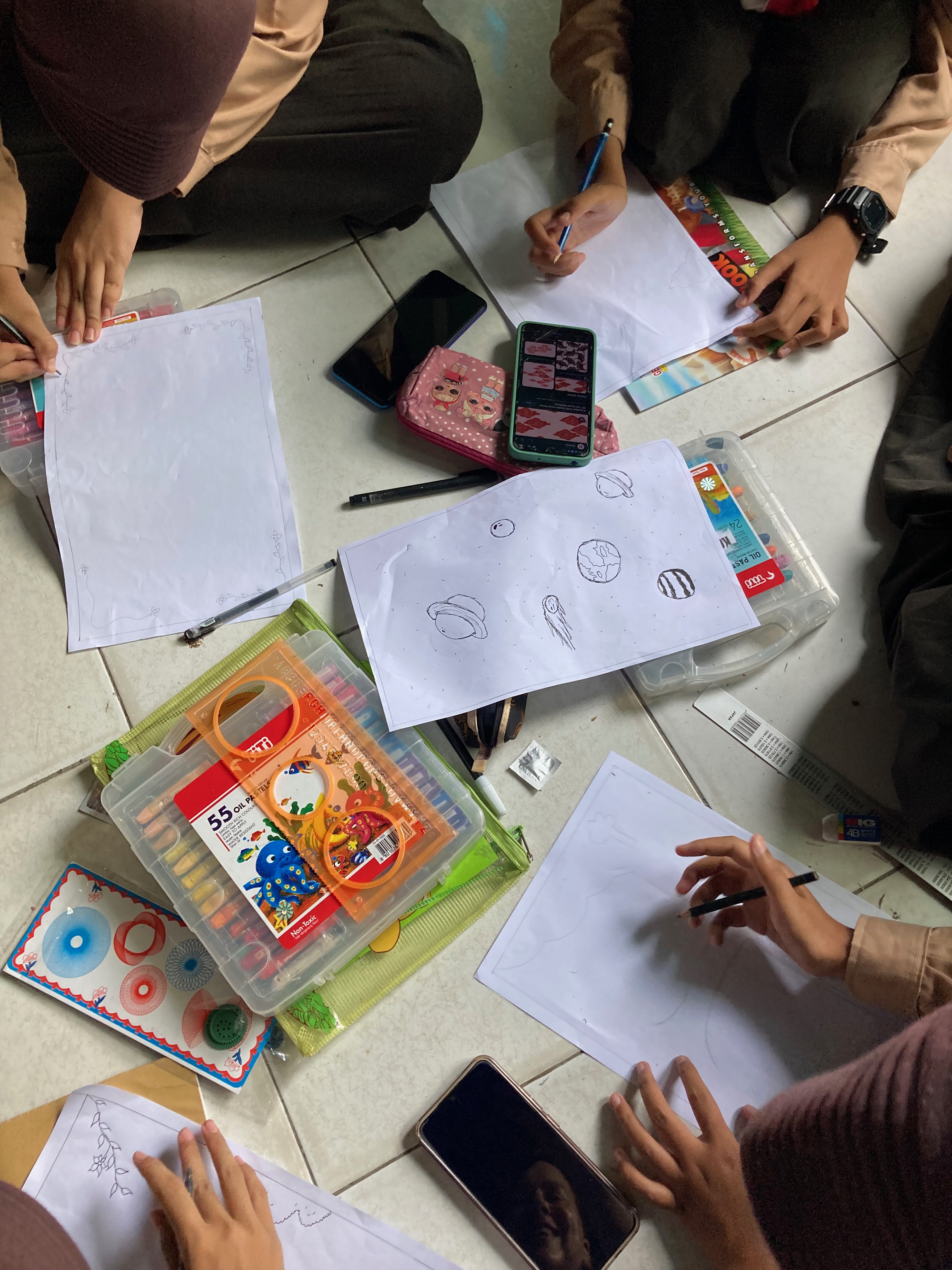
After the presentation, they started making a pattern individually on a small paper. I walked around, showing them my recently bought classic & modern batiks from Lasem & the region Rembang.
Phones were used to look up motifs, which resulted in many drawing ‘mega mendung’ which is a motif from Cirebon.
When all had a small drawing finished, it was time for the bigger paper, or actual have a break first, but most kids wanted to keep on drawing. 
On the bigger paper 6 or 7 children worked together, their small drawing could be used as inspiration to make batik design. They were invited to discuss how they would combine it. I walked by, showing some that were starring at their blank paper how they could repeat or use the motifs they already draw. 
When everyone got the assignment,  it was so fun to see what they made together, thinking how each motif could be featured. These kids are hard workers. Everything was done so precise, first with pencil, to trace over with felt-tip pen or coloured in with crayons. 
Most works didn’t get finished, and many requested if they could stay longer, but the lesson was almost done. So we ended with asking several to present their work. Although it goes with many laughs, they explained so greatly who made what and got many wow’s & applause from their fellow schoolmates. 
It was an amazing morning and experience, thanks Mbak Yullia for inviting me to SMP Negeri 2 Rembang, looking forward to return next year!

 Ibu Sulasmi, Ibu Suharti and Mbak Sri at KUB Srikandi

Ibu Ramini showing my photos

Saturday morning I returned to Ibu Ramini again. The batikmakers would be back and working again. Ibu Yullia joined me, since she got super excited seeing the batiks I bought from Ibu Ramini the day before. Even another teacher requested photos so she could buy as well. 
It was good to see Ibu Sulasmi again, and meet Ibu Suharti and Mbak Sri. At the moment Ibu Ramini only has five regular pembatiks and two come part-time when there is more work. Actually it was the same before the pandemic, so pretty stable if you compare with others. Mbak Eka had to let go of 1/3 of her pembatiks because sales has dropped.
We asked how the pandemic was to the makers. They stayed home about 2 months, but soon started working again, since income was needed.
We talked some more business with Ibu Ramini and about researchers in the region. Ibu Ramini pulled out proudly a photo-album which includes photos I took and one of me as a 25 year old and a postal package I send. It was so good to see how she keeps and cherish the things I send to update her on her growing fandom in the Netherlands.

More from Pak Soesantio's collection

After Ibu Ramini, Ibu Yullia dropped me of at Mbak Eka. Mas Pop was staying there so together we headed to Warung to eat and to look at some more archive. 
This time Pak Soesantio had a stack of old letters from a Sumatran businessman running batikshop in Pekalongan. I photographed them all, unwrapped some to photograph the backside. Again interesting material which Pak Soesantio is also happy to lend me if I want to make an exhibition.

Pembatik Ibu Lasmi of batikworkshop Nyah Kiok

The same design or over 50 years


Mas Pop wanted to show me a place before it was closed.  We went to again a beautiful Chinese home, yet this one looked abandoned. The owner passed away, recently, and the family who took over lives in Surabaya. Yet the batikworkshop Nyah Kiok located in the back of the house continues. The pembatiks come on their own accord to produce the most oddest batik, one single motif for over 50 years. The design with a red base of bamboo with two birds in it while butterflies fly above on a background of kind of ‘gunung ringgit’ has been made from as early as the 70’s accorded to the oldest, lead-pembatik Ibu Lasmi. Within 3 months 100 batiks with this motif are being produced and send to Surabaya, only leaving a hand full in Lasem. 
Shortly after our arrival the pembatiks finished their workday to return home on their bicycles. 

Pulang

Mas Pop had one more house for me in store before we headed to another beach. This old house had both a Buddhist and a Chinese altar in the home. The house is empty, but the altars are still lighted, with electric light, and offerings are made by the housekeeper. Outside it had decorated shutters, which includes a really strange cat. A magical and weird place. 

Beautiful, weird, magical house

With this cat! 


We ended the day at the beach, another beach with a route that passes by fishing-boats. One boat got pulled with the tide and got stuck. An amazing sight with the setting Sun, but the owner had to wait until 12 for the water to rise again.

Sunday was a relax day with another beach visit in the morning and lots of rain in the afternoon. While writing this I still have 1,5 hour to go by train, 13 hours on the road in total to Jakarta. But having a nice neighbour to make the time go faster.


Ayo, saya tiba di Jakarta, arrived in Jakarta, until next update!