Showing posts with label interesting nature. Show all posts

November 14, 2022

Ubud, Sumber Salak, Ungaran and Kaliwungu

At Sumber Salak in Jember

Ex-vulcano Ungaran

My short holiday in Bali didn’t really happen since my friend was really sick. Although I only saw Ubud & Tanah Lot, it was nice to meet this totally different culture in Indonesia; the many Balinese offerings, parades of nicely dressed people on their way to temples, ricefield with little shrines for Dewi Sri and sooo many half naked, burned tourists.I walked a couple of times the route ‘Bukit Campuhan’, a trail leading into Ubud city center to do grocery shopping. It was nice, and scary, to see insects & animals like ‘Kaki Seribu’ (duizendpoot/centipede) that I know so well as a batikmotif on the path. 
On one of the trips to get traintickets & cash for further traveling, I decided to head to the shop of Threads of Life. Their small shop in the center of Ubud displays Batik, Ikat and more in a stylish way. Inside I informed on the workshops. I first thought to just do the one morning workshop learning Batik & Indigo, but asked if I could still join the two days workshop on Natural dye the next day. “No problem”, the ladies in the store said, “just go to this address”.
So the next morning made my way through the ricefields, and the biggest flock of herons I ever saw blocking the road & hanging out in the trees, to the location. The place is really pretty, a small dye garden with a big covered outside space to do the workshops. 
We got a lot of information first. The team is so wonderful. Explaining in detail how to prepare the textiles and make the Indigo dyebath. Of course we also did all the steps ourselves. In the afternoon we got to dip our cloths in the Indigo vats. We even got to do some batik. I freestyled some local inspiration like the swallows I saw every morning and Balinese dancers. 
The second day we got to learn about dyeing black, yellow and brown. Our little group was already so much fun, funny how fast you bond, especially with the amount of washing our teacher made us do. The black was created by repeating a proces of tanning, dye and mordant. The dye is from mud from ricefields. To get the cloth dark black I repeated it about 10 times, maybe more, but it is very rewarding to see it change from “sheba cat” grey to black. We also painted with the mud, I based mine on the ‘Bukit Campuhan’ and the centipede I saw.
Wonderful to learn some more about natural dye and to be creative myself for a moment. 

Dyeing Indigo at Threads of Life

My batiks dyed with Indigo hanging to dry after boiling out the wax

The colour baths
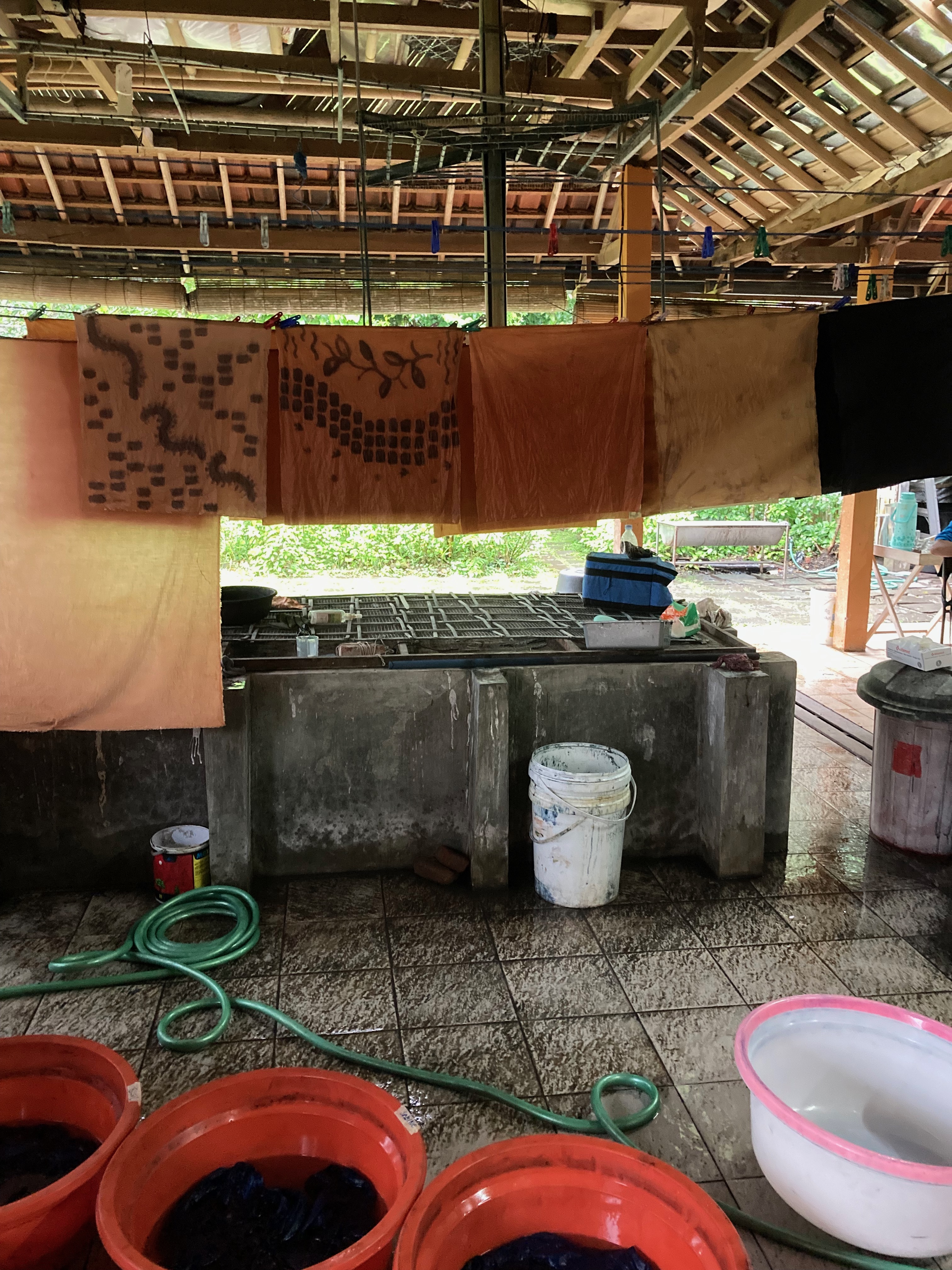
My piece dyed in cokelat (brown), kuning (yellow) and hitam (black)

Outside in the sun before the rain started

Writing this part in the train to Semarang, next to a loud calling man... I am half way through this journey, left in the morning from Jember. I didn’t want to fly back to Java from Bali. It would take two planes to get to Semarang. So I ended up taking travel, a car for 7 people to Jember, which was a whole new adventure including a part by boat and dinner at 1am. Now I am traveling by train to Semarang. First to Surabaya where I shared a grab to the station and had lunch together with a fellow traveller. 

Old translation Sumber Salak in Jember 

In Jember I spend one day to explore part of a Batikhistory I have been uncovering since last year.
Last Summer I saw the batiks made by Mary Herrmann for the first time, I knew them before and was fascinated by the story and portrait of her kept in the Tropenmuseum collection too. I realized the one who donated the batiks seem to have more to share and luckily I got in contact fast with granddaughter Mary.
So I went to Jember to visit the region Mary, the batikmaker, grew up and meet with a local batikmaker Mbak Endang who joined me on my adventure. 
In one of the Batiks Mary made is a detailed drawing of the plantation run by her father. A plantation with according to the family cassava & Indigo. Mary’s batiks are all blue and said to be made at the batikworkshop that was at the plantation. In advertisements in which the father tries to sell the plantation for many years a local station is mentioned being very close by. So we started there. The station ‘Sumber Salak’ is no longer active and is no more than a small platform. Don’t know if it was bigger in the past, but it was great to visit, especially since Mary made a batik with a scene in it about catching a train too. 
We explored the region nearby the trainstation. Asked around, but nobody (yet) seemed the know about a old plantation or old (Dutch) buildings. Although part of the buildings must have been from stone, buildings in the area made with woven bamboo seem to be similar to that on Mary’s Batik. Next time I have to prepare an exact location search on old maps, my visit here was pretty spontaneous…
The region is full with a mixed growth of coffee, sugarcane, jati, papayas, coconut and rice. No cassave or Indigo, but I did see cassave later when I went to Kaliwungu.
Trying to find a higher spot to see if we could compare the mountains Mary draw in her batik to the ones seen from Sumber Salak, we reached a sign saying 'Zona erupsi'. Apparently the volcano was/is active and we would enter the danger zone if we would go up further. The driver and Mbak Endang were discussing to do this. Although super symbolic considering my research on Von Franquemont and how Mary come on my path through this actually, I said we should not go further up. Better next time, when it is safe. But did asked if we could go to another hill or mountain to get a view of the mountains in the region. 
We headed to another high spot close by. Two natural green hills, Gunung Sepikul, that honestly look like two breast coming from the ground, provided a very beautiful ‘pemandangan’ {view}. 
If we saw what Mary saw not sure. Wonder if she climb on a rock herself to get the view or it is actually from a photo or drawing…
We headed to another high view that I visited in 2016. I got really bad news that day I was there and the person who accompanied me turned out to be really bad…Sooo I was happy to revisit this place, this beautiful region, and make new memories here. Drank hot chocolate milk while thinking about this. Cannot believe it has been 6 years, how we miss you David!

Traditional bamboo house in Sumber Salak

Mbak Endang at Gunung Sepikul in Jember 

The afternoon I got to visit Mbak Edang’s home and see her batik designs. She has been making batik since 2019. Inspiration comes from local traditions, Indonesian culture and even the Netherlands which she visited too. Next to making batik, she has a blog 'My Life Journey', inspired by me, she says. So fun to meet this batikmaker in person and have a spontaneous batik adventure together! Looking forward to returning here and explore further!

Batiks made by Mbak Endang

Writing this next part in Pekalongan. Arrived here by train from Semarang this afternoon, a short trip after many epic ones...
So after my one day in Jember, I headed to Semarang. Main plan was to visit my friend Aris. 
First time I met Aris was in 2009 when he was one of the young artists living in Rumah Seni, the place I stayed in when I was trying to find batik on my first ‘journey to Batik’. We met every time I visited, but now a lot had happened in between. Aris got married, has a son and build a home, in Ungaran! The place we visited together in 2019 and my research focus is on because of Von Franquemont. So perfect to combine some exploring with catching up.
Spend a large part of my stay in Ungaran staring at Gunung Ungaran. I did not know this would be my view when I booked the guesthouse, two others were full and this one is pretty new. It was a surprise waking up the first morning and looking out of my window. I now totally understood Cézanne and his obsession with Montagne Sainte-Victoire.
While he only painted/draw his mountain 30 times, I think I photographed and filmed it in 3 days way more. See my appreciation post on Instagram.
This ex-volcano has quite a reputation ~ mistakingly being seen as the one who swept away batikentrepreneur Carolina Josephina von Franquemont, while actually she passed away after a long sickbed.
If she did have a batikworkshop on the foot or slope of this mountain, or just worked by herself making the few batiks her family donated, is still something I am trying to figure out. So spending a weekend in Ungaran, staring at this mountain was wonderful while following her families footsteps in the region.
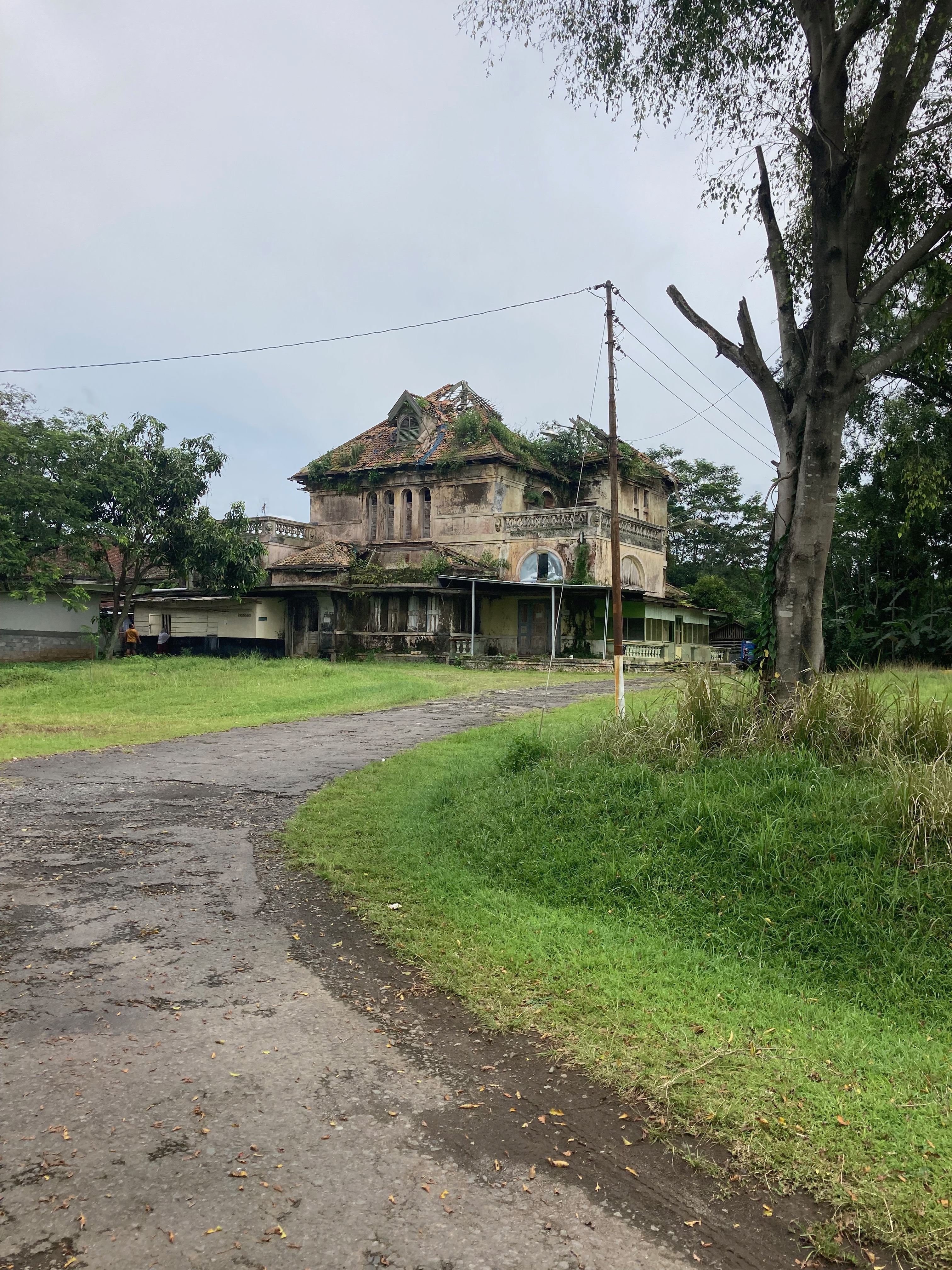
Gedung Kuning in Ungaran

Building from 1910 in the same street in Ungaran

Me and Aris drove around in Ungaran on Saturday, visiting places that were graveyards in the past. A long shot, but couldn’t resist reaching out to Mas Adnan Rusdi for specific locations and hoping.
Got three spots marked on Google maps, that all turned out to be nothing while also not being nothing at the same time. While the graves had all disappeared, a few only recently apparently, we saw some interesting old, European buildings, revisited a couple of places and just had fun. I am lucky that I have in this part of the world friends who just want to drive me to a spot on a map I marked while I don’t even know why! 

The last remaining building of the sugar factory Kaliwoengoe on police property;
 the 'waterpomphuis', with in the background the main building and guesthouse

View from the guesthouse on the 'waterpomphuis' and 'smederij', the factory would have been behind and next to the smederij

Guesthouse from the front, build after 1910 in Kaliwungu
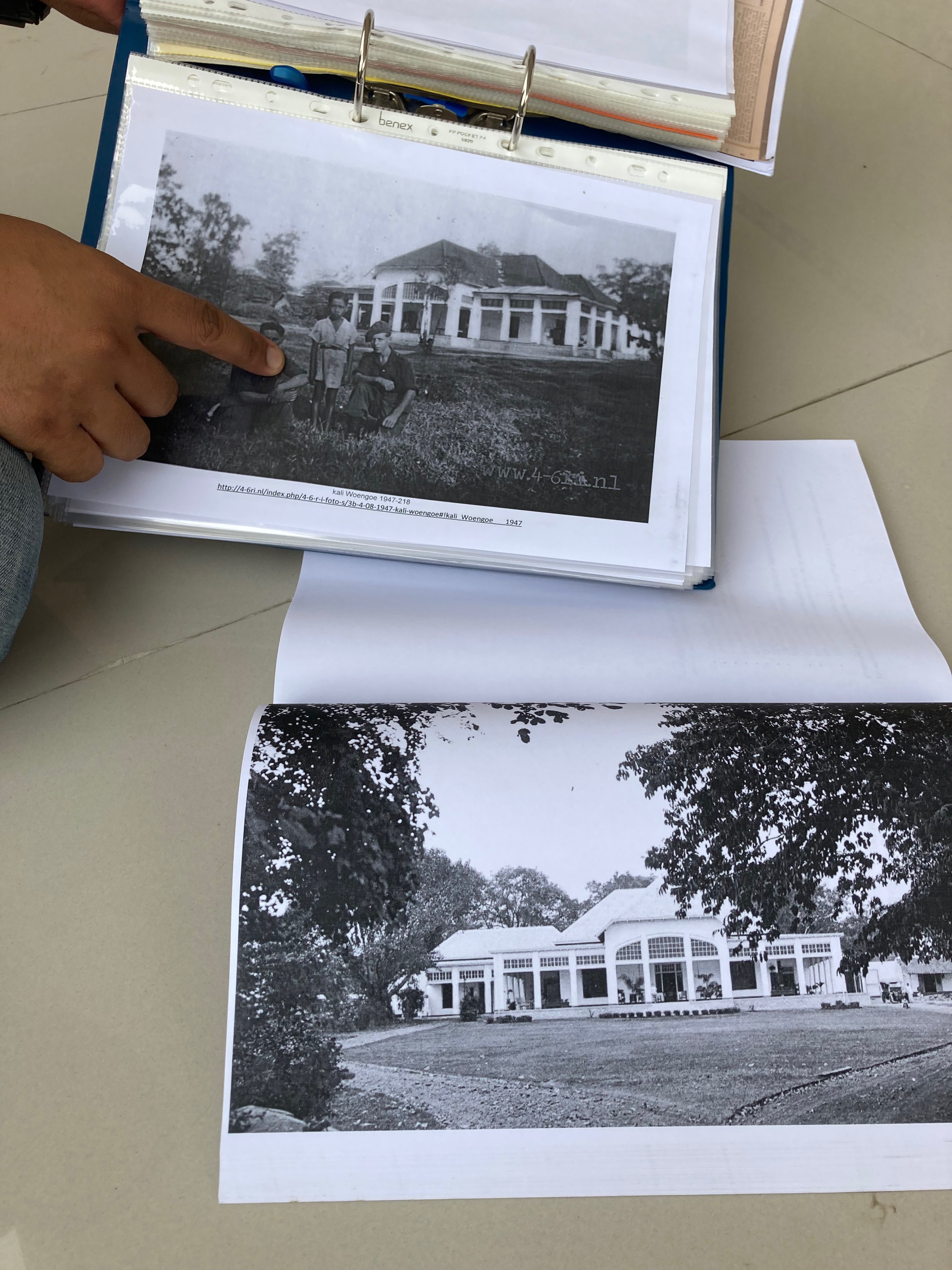
Mas Ruwanto sharing his data while explaining where is what and when

The next day I returned to Kaliwungu. This time in the great company of local researcher, might I say expert in Kendal history, Mas Ruwanto Tri, short Mas Iwan. We met online during the pandemic after Mas Iwan reached out after reading my blog about my visit to the sugarfactory Kaliwoengoe, or what is left of it, that was once owned by the sister of Von Franquemont
After my visit, construction started on the grounds that is owned by the police. Several building were build and old ones demolished. Mas Iwan was following the construction on side closely, sending me videos and photos through WA. Both worried that little that was left would be demolished too, we made a joined letter to the police asking them to keep the left over buildings in tact. Explaining their historical importance of no less then two centuries in which colonial rule, war, occupation and Revolusi all left there mark here. 
We still hope we can get the building officially protected, but since it is police owned this seem to be very difficult and we don’t know if we will be on time to do so (tips/advice/help is welcome!).
So returning to my visit, first I was really happy to see “our” buildings still there, and not looking worse. The growth around it is removed and maintained, so nature is no longer taken over these fragile constructions. 
Mas Iwan arranged for a permit for us to walk around and take photos, wowww! We even got escorted by a police officer, who gladly took photos of us in front of all the buildings. 
It was so great to be here with the expert; understanding how the buildings changed, some were renovated 3 times, which old photos were taken from which angles and where the factory actually was. To my surprise not on the empty field, but across the street. One building survived there too, the ‘smederij’. The building functioned later as a cinema in Mas Iwan’s youth, but is now empty.
It was so good to revisit and really have to put work in when I get home to see how we can turn the “waterpomphuis” in a small exhibition space to share this local history. That would be so fantastic!

Batik Fashionshow in Kendal

Mas Iwan not only arranged this amazing visit, he also made a Batik program for me. He asked around to see if we could visit local batikworkshops. He has been researching local batikhistory; tracing newspaper articles and reaching out to the familymembers. Currently there are no old workshops active, but new batik is being made. 
There was a small festival in Kendal where we saw a short part of a ‘Batik fashionshow’ with most contenders wearing printed textiles and visited the one batik stand. Bought two batiks, one kombinasi with all kind of local Kendalium (or Kendaalse?) reference and one with cap with the symbol of Kendal and a pattern of rice. Little did I know we would actually visit the maker. 

Mas Roni of Batik Linggo at work

Batik with prison design made in natural dye

After a beautiful drive through the region, heading towards Mount Ungaran, we reached Batik Linggo. 
Batik Linggo is run by Mas Roni who started it up 11 years ago, but has been active within batik 25 years. His main focus is education, so he gives workshops to local schools and people can follow a two day course learning Batik Tulis, Cap and natural dye. To my surprise Mas Roni knew me already. He saw my temporary carpet of natural dye at Museum Batik in Pekalongan. He showed us the batiks he made with natural dye with interesting motifs based on nature and even a prison.
Really hope to return here and do a workshop. The view from his place is fantastic!

Me & Mas Ruwanto Tri in front of the 'waterpomphuis'

Feel so lucky Mas Ruwanto organised all this. I know he is very busy and it means the world to me he makes time to spend the day with me and then I get so much more. So thank you Mas Iwan!

Next couple of days I am in Pekalongan, my last two weeks on Java before ‘pulang’, returning home.


November 25, 2016

Madura

Stasiun Tugu in Yogya

On the ferry to Madura

This passed week, 10 till 19 November, was about friends. Making new friends, visiting old friends and missing friends. Times are tough and I hope this post will offer some distraction. 
I'm writing this in the train from Jember to Yogya on Saturday the 19th of November after seeing my dear friend Denny again after 7 years. But first let me share "my trip" that was indeed "my adventure".
My visit to Madura was a seed planted many years ago. In 2009 I had a nice conversation with my hotel neighbor. It was on the my last days of my first journey and she told I should visit Madura next time.
About two years later Rusmilawati was studying in Leiden so we met again. She invited me to visit Madura again if I went to Indonesia. Preparing for this second journey, I of course contacted her.
Wien, as her friends call her, is now doing her PhD in Solo and is a lecturer at the University. 
On the beginning of my journey I met her in Solo at the Payung Festival (see blog post 'Yogya & Solo').
Our journey to Madura started on Thursday 10 November early morning by train to Surabaya. From there we would take the ferry.

Already in the train I noticed the landscape changing with more open spaces and hard working people. In Surabaya we got picked up by old students of Wien, now lawyers. We had lunch at, I think, a famous place 'Bu Rudy' and I was enjoying seeing a bit from this city from the car.
At the port we ran to catch the ferry, but missed it. Well we could have jumped for it, but I rather missed it this way.
Waiting for the ferry, I already spotted some nice traditional Madura Batiks being worn by the sellers of soda & snacks. 
On the ferry I felt so excited, I don't know what it is about going to islands, but it is such a great feeling of adventure. Of course Java is an island too and Madura is really, really big, but still.


It was the Lampion Festival that weekend, so the port was decorated with beautiful lanterns. Wien's father picked us up in his mini-van and I felt like entering a different world. I can't explain exactly what makes it so different, but don't believe the blablabla on Java.
Everything looks really pretty. All the public green in the more city area's are managed with real care. Amazing for this weather, I can not keep my garden so neath and we have like no Summer! We passed houses with bright colours and fields with trees very different from Java. I liked Madura instantly.

Made of bottles and plastic spoons

Peacock made of a tire & cd's

The next day I went with Wien to her campus. The highest building on Madura is on the campus of the university. How smart are these people! The world can learn something from this!
In the afternoon we headed towards to Lampion Festival. Unfortunately there was no program yet and rain started soon after our arrival. We walk around looking at the lanterns till the heavy rain made us look for shelter. One of Wien's friends just arrived when the rain start pouring down. It was strange and fun at once. The rain turned the festival terrain into a river, so the program for the evening got cancelled. When the rain didn't get less, Wien's brother kindly picked us up, saving us from a very wet motorcycle ride.

Mangrove

"Strawberry" design

Batik Tulis design should be two sided drawn with wax

On Saturday the friends with whom we hide from the rain, joined us in our journey to Batik. Because I don't know much about Batik from Madura I was very happy we got someone who arranged a meet with a Batik seller and maker. We headed towards Tanjung Bumi. A bumpy ride, but with great views over land and sea.
We first went to the Batik seller. To my surprise the Batiks were only draw on on one side. So only the front had a clear design. But I was pretty sure it is was not printed. I didn't know if this was something typical for Madura Batik or that there was something wrong, but I learned I should trust my knowledge about Batik more if I feel it is not right. I picked out some pieces with a more visible design on the back and asked for the prices. I thought they were a bit high for one sided Batik Tulis and I saw her quickly removing a price sticker of one of the Batiks I opened. I couldn't figure what was going on. We went to meet one of "her batikmakers. The batikmaker was a kind women, but I saw non of the batiks the seller sold back in her handwriting. She showed some finished pieces of which one had some elements I saw before. I had the feeling she was not the maker. 
I liked one design very much at the seller, a modern one with a motif of "strawberries", so I asked if she was the maker. I got from her a surprised face and later Wien told me the seller was urging us to go when I start asking more questions.
Back at the home of the seller, I did bought some of the neater made pieces batiks. I let her know before that I thought the prices were a bit high and she ended up raising them even more...
Feeling a bit distressed, our guide said softly when we were back in the van, yes its true, she raised the prices. At that point I  was just hoping I didn't buy fake batiks...
After seeing a new, yet still magical and my first mangrove ever, Wien showed the bought Batiks to a neighbor, her mother and brother. They actually said I made good chooses. They had no explanation about the back of the pieces, but said the process of the Batik was "unfinished". There is a slow, long process on Madura of keeping the batiks in clay to make the colours different and the fabric more soft. These batiks had some treatment, they have a kind of shimmery, but not the whole process was completed.
My own theory now about this seller is that she sells mistakes. So Batiks she can buy for a lower price because something in the process went wrong. I still think and hope it is actual Batik Tulis.

The actual "Strawberries" are I think a classic design based on a cactus fruit that is eaten on Madura


Batik at Tresna Art

Traditional breakfast in the garden of Tresna Art

On Sunday we went to another Batik place. A shop in Bangkalan of which I had no expectations being familiar with Batik shops in Yogyakarta. But Tresna Art is truly something else. In a beautiful building with batik makers at the entrance and all shorts of Maduran traditional things, I saw the true Madura batiks. Really detailed, very fine and very expensive. I regretted I spend my money already somewhere else...
Because it was Sunday there was even free traditional breakfast in the garden. The garden was wauw! With traditional buildings, bonsai's, cactuses and exotic birds. After the breakfast and lunch we were asked if we wanted to see the batikmaking. But of course!

Ibu Sofi

Ibu Sutyah


One of the batik makers stopped when we were watching and I wondered why. I asked some questions about the motifs and realized this pembatik had only one arm. Ibu Sofi told she started making batik from the age 10. We asked if she wanted to show us. Her work is really detailed and it is empowering she created this with only one hand. She uses her knee to put the fabric on. Normally the other hands guides the textile and keeps some distance between the hot wax and the skin. So a tough lady who makes the finest art!
The pembatik next to her, Ibu Sutyah, started asking Wien why I was on Madura, probably noticing my interest in Batik. She got really angry, or at least thats what Maduran sounds like to me, when Wien told her about our experience the day before. Apparently the seller we met is know for her too high prices and she said: Why you didn't come here first? She explained that the owner of Tresna Art is a true supporter of Batik and other traditions. She is fair to the batik makers and helps preserving the technique of the clay and other important things for Madura Batik. I was told people from Madura are known for their direct character and I believe she was not saying these things just to please the boss.
She said that next time I visit Madura, I first come to Tresna Art and she will be my guide to her village. A village were most people make Batik. She said "They are true and honest people and will show you the Art of Batik of Madura." I can't wait!!


Thank you Rusmilawati for inviting me to your wonderful home on this beautiful island. I hope I can explore more of Madura and its fascinating Batik culture in the future. Wonderful to meet your family and friends and so funny we are now on the same train!!

November 4, 2016

Batik, Cethe, Tari & Kartini


Our last day in Jeruk, Lasem & Rembang was spend well. It started with documenting the tough process of boiling out the wax from the previously dyed Batik cloths. I saw this a few times before, but not like this. Ibu Ramini dipped the cloth barehanded in the boiling water. She dipped the end of the cloth in some cold water so she could turn it and do the other side of the cloth. Her collegue Ibu Juwariyah with whom she dyed the cloth the before, was pressing the just boiled cloth with her feet to remove the final traces of wax. 
An intens process which is hard and hot to create such delicate beauty at the end!


Because our flight got put to an earlier departure time, we had to fit more in our last day. We headed to Rembang to visit the Museum Kartini. Or better, the last place she lived. I still which to visit the place in Jepara were she is from, but that is for a next journey...We had a nice guide who appreciated my Kartini shirt. My Kartini shirt got actually dyed the day before in a great "chocolate" colour after I couldn't get it white anymore (Idea credit from Barbara).

Photo by Jennifer

After Museum Kartini we headed for syrup & coffee. The store sells al kinds of Chinese sweets and the Kawista syrup is their specialty. It had many names, but I believed the logo stayed the same. The Chinese folktale of the the boy on the back of a phenix. The logo is also on their bottle caps and I got some to make earrings!
After the syrup, it was time for coffee. I can always drink coffee, but this place is different. Here they make the cigarettes decorated with coffee calked Cethe. I heard about this from Pak William Kwan a few years ago and was happy he reminded us to go and see it (see post "All we can give as presents..."). We were very disappointed no one was there to make it, but we ordered a coffee anyway. A few minutes later a man arrived who was one of their regular customers who knows how to do it. He didn't mind showing us. He decorated a whole package while smoking and sharing stories about how he was invited to show his art in Jakarta and got to nervous to make it. He had no nerves at all now with us sitting starring at his hands.
So great to see this art live!


Pak Saefozi making Cethe at Warung Kopi Pak Ndut

It was time for the Tari Batik, so we headed first to Ibu Ramini to get my things and then to Ibu Maryati. I arrived at the house and next to it hang a long line of black with red Batiks out to dry. The image was so beautiful. I decided to change the location to film, when Dwi was wearing a red kabaya and a black with red batik from her mother. If I have set this up, it wouldn't have been so spot on. She finished her first performance and the wind waiting till that moment to blow all the batiks up...
Dwi changed into her regular clothing and we headed for the field nearby. I was very happy with our great driver Pak Pri also being my assistant. Dwi arrived and performed a second time with an audience of 10 young boys. The boys set down and watch mesmerized, absolutely quiet. She finished her dance and we gave her a big applause. I didn't want to put her more on the spot, so I announced it's a wrap. I saw relief and pride on her face.

Dwi performing Tari Batik

Leaving Jeruk was with true heartache, I know I will return again one day, I just have to!

October 31, 2016

Returning to Jeruk and Lasem


Writing again in a plane. This time from Jakarta to Yogyakarta. I had a wonderful, I think, truly Jakarta life-style week and happy to return to the more quiet life in Sleman (where I wrote most of this post).


On Monday 17 October I returned to Jeruk after exactly 7 years on the day (see blogpost "Jerukposted on 18 October 2009). 
I left early from Yogya with a driver to Semarang were we would pick up Jennifer. After a 6 hour drive, the landscape suddenly changed into the landscape I remember so well (see post "Landang garam"). 
I only been once one day to Jeruk and Lasem, so it is interesting I have such a strong connection with this place. But yet again, I felt as if I was returning home. My plan was to stay at Ibu Maryati, but it changed last minute, so I stayed at Ibu Ramini. To my surprise this was The Place I dreamed of visiting for so long. So it was meant to be.
The first thing Ibu Ramini asked Jennifer to ask me was: "Can't you stay one month?". Wauw, I really wanted that and wondered if I should change my plans...but I'm sure I will return and stay longer one day. 
Jennifer helped me explaining what my plans where and we were in luck that the next days the dyeing & the boiling out of the wax would be on the program.
Ibu Ramini remembered me well because she showed us a photo-album with the photos me & Tommas made during our short visit to Jeruk in 2009. I think I send them with my Batik design in 2011, but Ibu Ramini didn't remember that. Probably because it was at the time arranged with Ibu Maryati.
After our short catching up, we headed towards Ibu Maryati. She started her own Batik workshop at her home. I talked with Hanip and Dwi, the daughters of Ibu Maryati, to see how we would film the Tari Batik two days later. For me an inspiring household with three generations of Batik makers and with the youngest generation studying fashion and dance.


In the evening we were invited to eat a local dish at Ibu Ramini: Urap Latohan. A kind of salade with cocos and the seaweed that is used as a pattern in almost every batik from that area. You can't eat this dish the whole year round, so again we were lucky.


After a early bedtime and a early wake up, I started filming the colouring of the batiks. Brown, cocolat and red were on the planning. The colouring of the red looks like a magic trick. In the first dyeing bath only a blueish tinge appears on the cloth. In the second bath the cloth suddenly turns red. I hope I captured this well...


Jennifer brought with her the skirt and dress made from the Batiks I selected in Jakarta. Good idea of her to do a little photoshoot at the place they were made (well one here and one by Ibu Maryati). Me feeling goofy and nervous ended up being a bad model, but I made the batik makers laugh.


When near Lasem, you must visit Mr. Sigit, so we headed there next. The doors was closed, but his grandson welcomed us in. At the entrance only 4 or 5 batik makers were working, I remembered Pak William Kwan telling me about this, but I was happy to see there were 10 more women working around the corner. Nothing really changed at Mr. Sigit workshop, maybe less workers, but no big changes at first sight.
His grandson showed us some wonderful pieces and also new designs with Arabic texts on it. Maybe it is the influence of this new generation, happy to see and meet this new generation. I picked out one Batik for my own collection with a base in red with a pattern of peacocks and fish. Finally a finished piece from this workshop in my small collection!
Mr. Sigit wanted to meet us when we were just done shopping. He was standing in the door opening and said in Dutch something like "You come back from the Netherlands". I don't know if he actually remembered me, but he was really happy we were there. Mr. Sigit is now 88 years old and we were surprised to hear that the Batik workshop started with cap in 1923. It wasn't until 1967 (or 1976, I'm not sure) that they started with Batik Tulis. Nowadays if we talk about Batik Lasem we talk about the batiks from Sigit Witjaksono. It was nice to visit him again and to see a new generation ready to continue his legacy.


To stay in Batik Lasem theme, we visited two very old (more then 300 years old) and beautiful Chinese temples. There are theories the Batik motifs used in Lasem are based on artefacts & ornaments found here and I think I can agree with that.