October 5, 2022

Splendours of Malay World Textiles and more in KL

Batiks in John's exhibition 'Splendours of Malay World Textiles'

Together with John Ang, the new Vlisco wax print I brought in the display on Batik Besurek
in John's exhibition 'Splendours of Malay World Textiles'

Writing this from my hotel room in Jakarta where the jazz played in the hallway mixed with constant buzz from the AC in the room upstairs. Almost a week has passed since I had my last full day in Kuala Lumpur, Malaysia before traveling to Jakarta. 

On Thursday it is the Batik Friday of Malaysia. Huh what? Friday’s in Indonesia are known as Batik Friday. The day everyone, mostly government employee have to, wear batik. The idea behind batik Friday’s was that more people had to wear batik, so more batik would be bought and therefor better protected. However most people do not wear Batik on Friday but go for the cheap mass-produced printed textiles, unfortunately…In Malaysia this day is on Thursday. I don’t know if people here were more real Batik or not, but we celebrated it by wearing batik and seeing Batik!

One of the domes in the Islamic Arts Museum Malaysia

Curator Marina of Islamic Arts Museum Malaysia 
gave us a tour though of the textiles in the museum

Textiles on display
at Islamic Arts Museum Malaysia 

Detail of Batik and Telepuk

Textiles on display
at Islamic Arts Museum Malaysia 

We started our day with a visit to the Islamic Arts Museum Malaysia. We had a meeting with Curator Siti Marina Modh Maidin. Up on arrival the building is already spectacular and inside even more, with decorated domes and marble floors. Marina started with saying there wasn’t much Batik in their collection, to continue showing us all Batiks on display, which included amazing Batik Besurek pieces!
New ones have been collected and will be added in the exhibition they are working on behind the scenes for 2024.
The museum show Art, Crafts and Fashion from the Islamic world in all it diversity, beauty and development. It was refreshing and stunning to see how everything was displayed without pushing an agenda. We only saw part of this private run museum, but I definitely will revisit next time I am in KL!
 

'Conference of the birds'

A Besurek Batik...

with Gelatik, rice bird motif, what a dream!
On display at Islamic Arts Museum Malaysia

Our next visit was to the exhibition ‘Splendours of Malay World Textiles’. Finally! The exhibition made by my dear friend John Ang. It was one of the main reasons for me to go to Malaysia. The talk in Singapore allowed me to travel here first, before continueing to Java, where I am now. 
I saw my friend John Ang last in person in 2019. We stayed a weekend in Bangkok together, enjoying the exhibition of the batiks collected by the king, good food and many laughs.
Of course we were in contact regularly after through WA. Mostly discussing certain things John read somewhere, a textile he found or when I posted a recent find online. Whatsapp is nowadays the letters scholars use to send back in the day to each other ~ I do wonder how anyone can retrace our steps later with our messages through WA, Instagram DM’s, Messenger, the occasional email and phone call, on top of the many conversations in person…

First wall in in John Ang's exhibition 'Splendours of Malay World Textiles'

John telling us about the categories and the time it took to collect all the pieces

Woodblock prints and Batik Cap in John's exhibition 'Splendours of Malay World Textiles'

Telepuk, gold pattern on top of woven checkered fabric 

Batik Tulis, Woodblock prints and Batik Cap 
in John's exhibition 'Splendours of Malay World Textiles

More woven checkered fabrics with stunning details
in John's exhibition 'Splendours of Malay World Textiles

All the pieces are stunningly paired to make complete stories AND outfits!

Throughout the pandemic John was working day and night to make his exhibition. From his extensive collection he selected, I believe it is, 500 pieces to show in 12 categories the splendour of Malay textiles. 
With zoom meetings John shared with us the different categories and the places these textiles are from. There are different opinions of what places and countries are part of the Malay world and there is even some controversy on the use of ‘Malay’ as a way of grouping the ‘Nusantara’, which I cannot explain in much depth, but lets say unity in diversity is a difficult concept to realise. 
When the selection was made and the grouping in photo collages was done, a team of people build up the exhibition spending weeks ironing, hanging and pinning the carefully selected pieces. A labour of love!
Although I saw many photos during the process and from when it was opened in July, seeing the exhibition myself and getting to see the textiles up-close was an amazing experience. It is rear so many textiles are displayed, and these textiles are not behind glass, so you get to see all the details.
John invited us to join a tour he was giving to a group. Turned out it was for the Islamic Arts Museum we just went to. 

Tour by John

British prints that found there way onto the Malay market
in John's exhibition 'Splendours of Malay World Textiles

Detail of Kain Lamar with calligraphy motif
 (please correct me if I am wrong)
in John's exhibition 'Splendours of Malay World Textiles

Tour by John

Patola's; originals woven in India, blocked printed ones 
and a copy from The Netherlands made by De Kralingsche Katoenmaatschappij
in John's exhibition 'Splendours of Malay World Textiles

More colourful prints

Batik Tulis, Woodblock prints and Batik Cap 
in John's exhibition 'Splendours of Malay World Textiles

I was so happy that we could join a tour by John himself. The stories he shares on why certain pieces are grouped, the history they reveal and personal anecdotes make the exhibition come alive even more. You can book tours, so certainly do when you go to see the exhibition
Johns story, the marvelous display and all historical details really make me look forward to the book, the catalog, that will follow this exhibition even more! 
When the group of the museum had to leave, and John called me “Sabine, we need you here”, for the last room of his exhibition. To my surprise the Vlisco imitation Besurek I got for John in the Summer of 2019 when he was in the Netherlands was featured here. John told how I told him how I found out Dutch imitations were made in the 19th century that now made their way into collections often mistaken to be real batik, like the one at ACM.

John Ang telling about our Batik Besurek discussions

After the tour, I was happy I could ask John to unwrap the present I brought him. Vlisco just released before my departure a new version of the imitation Besurek in purple decorated with rose gold (like prada). John showed it to everyone and we had to pose with it in the exhibition.
John invited us after tea for dinner. We went to this really stunning Peranakan Chinese restaurant. John was inviting someone in the car on the way there, I asked who will join us. And it was Thweep Ake Rittinapakorn, the Burmese textile researcher I got to meet in Bangkok for pies when I was with John there. Such a nice reunion, and it seems there are Dutch ~ Burmese textile histories we much explore further in the near future. 
After dinner, John insisted on is seeing his home. We were all tire, but were super excited to see his home. It was almost midnight, so we would only look around quickly. John wanted me to also look at some Batiks. I said no we should sleep, but looked at a couple before going anyway since a no is luckily not accepted. Again amazing pieces that I tried to date as best as I could and wish to dive into further when I am back. 

Blok from John's collection 
with grape motif I have been fascinated about for a while now


Looking forward to next time, when I will stay longer John, I promise. 
Enjoy the lost month of your exhibition!
If you are near KL go see it, a must see for sure. If you are far, go see it too.
More info on www.johnang.com.my


October 2, 2022

Batik Terap of Terengganu, Malaysia

Batiks hanging to dry at Batikworkshop owned by Wan Azhar, 
Terengganu, Malaysia

Thunder when driving to Terengganu

Batikmakers at Batikworkshop Kamis

Because we departed a day later than planned, we spend one night in Kuala Lumpur before traveling on to Terengganu. So me and Tony first took a bus to KL, a pretty long ride which allow me to write my previous post 'Holding Batik closer to our heart'.

Batik in Malaysia is mostly done by men and in Terengganu only by men. They make Batik Cap which is called Batik Terap or Batik Blok in Malaysia. We got to find out there are much more differences and found a, for me, new technique, discharge. Which apparently is also used on Java. 
Batik was, same as on Java, on the brink. More than getting makers out of poverty was all that could be done basically. Sadly the pandemic brought most efforts back to zero or worse, since batikmakers had to find other work and haven’t return to workshops still. 

During our long drive to Terengganu we saw mainly oil palm. Row, row and rows of it. Apparently this the oil palm is not just used for palm oil, which most products in Europe are made with, but it is also used as a “green fuel”. A complex struggle between needing the income, needing to bring down CO2, while loosing nature and the connection to it. 
Happy when the endless rows of palms made way for some more forest like hills and also very bad weather.

After our arrival we soon made are way to a cultural festival, Langkasuka Cultural Festival, being held in a local mall. This mall, the buildings around it and a flat were build were the former creative kampong was filled with batikmakers and musicians. Under the flag of ‘development’ the people of neighbourhood were relocated in this flat. Most batikmakers stopped working, some found work at the left over batikworkshops elsewhere in the region.
At the festival we met met Zakaria Ali Bin Ismail displaying his Cap/Block/Terap making skills at the mall. 
The next morning we met Pok Ya for breakfast. We chatted a little in Bahasa Indonesia, since he mastered the Art of the Cap making in Indonesia. As most makers did. 
Batiks was before it was made locally imported from Java. And the first Malay batiks were actually not made with wax resist, but printed with colour blocks. 

‘In Malaysia the meaning of batik is much larger than a simple definition of the physical batik process. For most Malaysians batik connotes certain design characteristics and particular motifs. 
The process is secondary.’

During the trip got to read a full bag of books on Malaysian batiks, so wonderful & as the book lover I am, I scanned read them all. In the book ‘Malaysian batik: Creating new traditions’ from 1987 was the explanation above.

Pok Ya, the last blok/terap/cap maker of Terengganu

Pok Ya's workshop at home
 
Back to Pok Ya, he started learning from age 22 on Java, traveling to places like Solo and Cirebon. He since then adapted the blocks, as they are called here, into a lighter weight, yet bigger shape, easier to repair, with a more open design.
After breakfast we got invited to his apartment, which is located on the ground were the former, flourishing creative kampong was. The kampong was also next to sea were Pok Ya gave workshops at the beach. The seafront got turned into a road in the early 2000’s. A final blow to this batik location.
Pok Ya operates from this flat, having a tiny workshop in his home and when he does the wax process, he uses the empty hallway. 
All the batikworkshop we visited next worked with blocks made by Pok Ya. He had students in the past, but their often less quality made block got send still to him for repairs.
Pok Ya is almost 70, a Master in his field, yet the last one standing. 

After our visit to Pok Ya, we headed to the local textile market, temporarily housed in Pasar Kedai Payang. The market is filled with tiny stores, filled with piles of textiles. They actually sell real Batik there, but one need to know how to navigate. 
Since I am not know with Malaysian Batik yet, for me it was surprising to see how different the batiks designs, colours and effects are. Batiks are next to wax resist with cap, decorated with marbling. A technique used to dye textiles and paper (used back in the day for the insight of a bookcover) known under names like ‘Suminagashi’, floating ink, in Japan, and in Turkey as ‘Ebru’. As the discharge technique, the marbling gives a unfamiliar layer to the Batiks for me. The effect can be quite busy, but also stunning. I brought one example for my collection at home.
While on Java print will be sold next to Cap or Tulis also, on the pasar in Terengganu it was not made a secret which was which. The real batik was on separate piles and had a higher prices, twice sometimes of the fake ones. Still it is of course sad so many mass produced items are sold, next to handmade pieces. Especially considering the shape the local Batik market is in…

Batiks made with wax resist Batik Cap/Terap & marbling

Printed textiles next to Batik Terap and machine woven checkered fabric

Miss Ain hand-dyeing the Batiks at Batikworkshop Kamis

After the market we made our way to the Batikworkshop Kamis, named after its owner Kamis. Here we got to see the full making process. I saw some photos before of the workshops in Malaysia, but seeing it with my own eyes was enlightening. 
The first space we entered had the batik cloths stretched out between wooden frames. Mas Lokman and Miss Ain were dyeing the cloth with a big sponge. I knew here ‘colet’ was done, handpainting in the colours, here called ‘conteng’, but also the larger parts are done by hand. And seem to be considered better than a colourbath. The stretched fabric can have a length between 2 and 4 meters, in the past longer even, but that seems no longer to be done. They make either kains/ sarongs or kaftans. Especially kaftans seemed to be popular in the mall. The batik is locally only worn at home and not turned into clothing. Brands in Kuala Lumpur do produce here to turn it into fashion.
In another building the terap was being done. Bapak Kamir, Cik and Hogan were working their rhythmic magic placing the blok with ease in repeating patterns. 
There were also batiks being boiled out and hang to dry. A active morning for one of the bigger workshops here. Made a reel on my instagram of the making process, check it out here!
After the tour, we got to shop some freshly dried Batiks. The colours are really stunning at Kamis, many purples which I love and the designs are mostly repeating graphic patterns. 

Bapak Kamir at Batikworkshop Kamis

Batiks after 'lorod', boiling out, here called 'rebus'

Hanging to try

In the last chapter of also the book ‘Malaysian batik: Creating new traditions':
Sherry Ortner categorizes symbols on a continuum ranging from "summarizing" to "elaborating” (On Key Symbols, 1973). Summarizing symbols synthesize the entire system, representing the system as a whole. A nation's flag is an example of this type of symbol. While a flag, a uniform, or the national emblem are recognized as national symbols, national symbols need not be specially created objects reserved for ceremonial use; they can also be "nouns and verbs" ', utilitarian objects, abstract concepts, and events. Thus, the concept of national culture can be a symbol in itself which guides people's actions and helps legitimize their activities in modern Malaysia. Batik as a craft and as a costume can be considered a symbol of the nation in this summarizing way.

Batik patterned outfits in China Town, Terengganu

Entrance of Terengganu State Museum

Our next stop was the local museum, Terengganu State Museum. A huge place, consisting of huge building that are beautiful, but surprisingly empty. We never the less enjoyed the textiles being display fully. Lovely pieces, showing early batik imitations, the other stunning Malaysian textiles and the technique. Little info with the pieces however. No dates, location, provenance, only name of the motifs. 
Outside the museum buildings is a little open air museum with palaces from the past. These wooden houses on poles are sooo sooo stunning, and very cool inside (as in not hot). 
In Terengganu are many houses from wood on poles still and I am so in love with them. Painted in bright colours; aqua, lilac, blues and yellow. Looking like a perfect place to live with chicken walking underneath the house. 

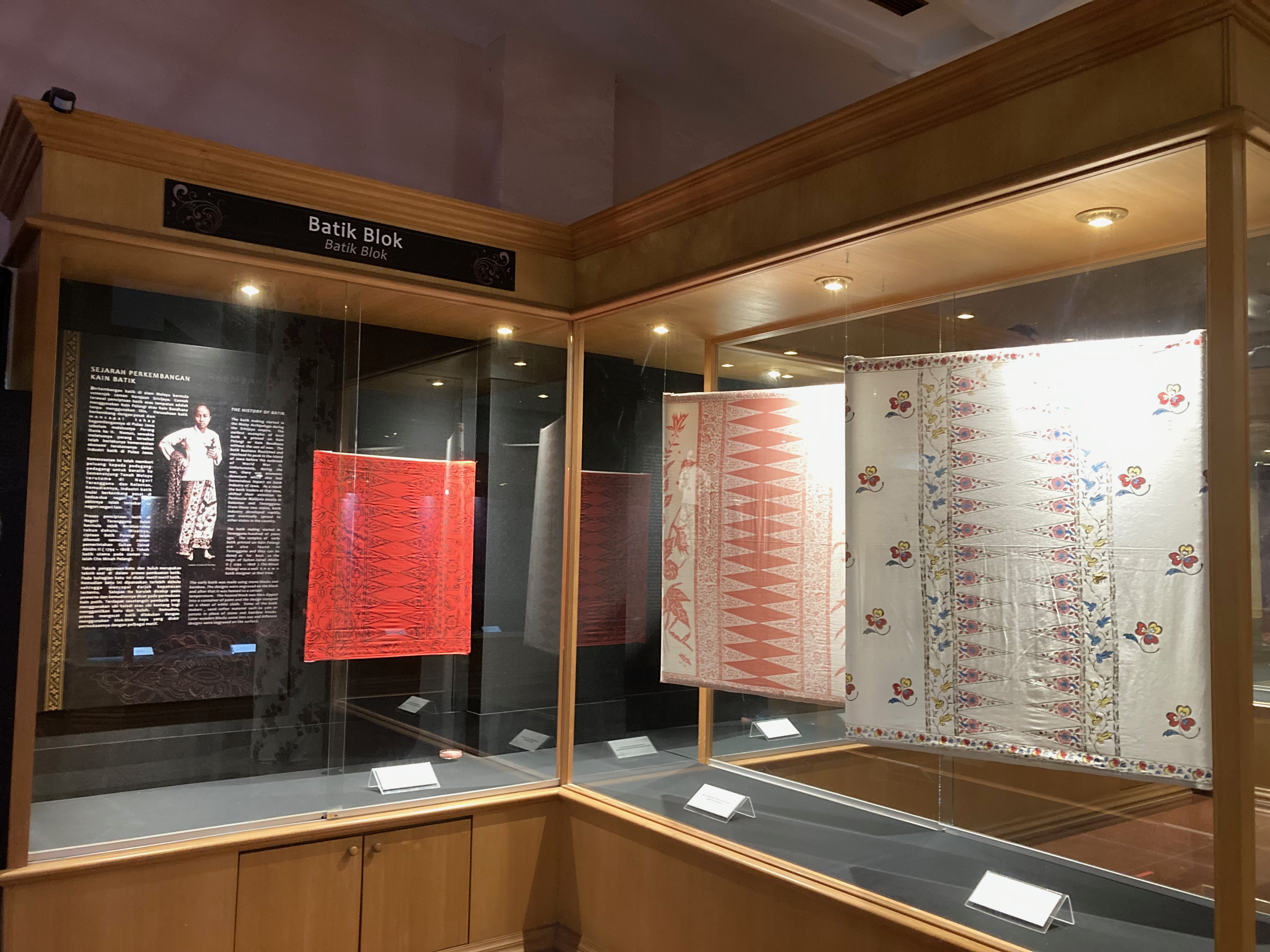
Textile display 'Batik Blok', colour block printed textiles 
at Terengganu State Museum

Silkscreen printed textile
at Terengganu State Museum

Palace at Terengganu State Museum

In the evening we returned to the mall to meet Batikartist Razak again. We fell the first evening for the Batik banners he made displaying local traditions. The batikpainting he was working on, was finished, showing a local tale of a warrior princess. 
Tony will bring work by Razak to aNERDgallery in Singapore soon!

Batikartist Razak with one of his banners 
on which the Art of Batik making is depicted

Detail of the work made by Batikartist Razak 

On our second day we visited the Batikworkshop owned by Wan Azhar. Up on arrival we only encounter one employe  still handeling the cap, En Fuad, and one taking care of the wax, Awang. All others went off to fish, which is not unusual here, most batikmakers are actually also fishermen.  Actually fishing pays better than making Batik, but you cannot always fish or make batik, so the combination works great. 
At Batikworkshop Wan Azhar we encounter the discharge technique, new for me, but used from the 1990’s, maybe earlier. I also heard it was/is used on Java. I never saw it before or realized it was made with wax resist since it is batik in reverse. The cloth is fully dyed first, then stamped with wax. In a bleaching agent the colour is removed again, keeping only the colour under the wax lines. It seems to be much afford, but the effect is pretty stunning and unique. Not the most sustainable way to make Batik, using bleach and something called ‘ACL China’. It is done because here the to fully cover the cloth with wax seems like a waste, while on fact the wax can be re-used. Curious to find out more about it.

Bapak En Fuad working on Batik discharge

Batik discharge hanging to dry

Workshops is at the waterfront

Mbak Fidah folding the sarongs

There were many bright coloured batik sarongs hanging to dry and when we went to the shop, we were told we could “pick from the washing line” since there was little stock. Batikworkshops here carry little stock, most is done pre-order for resellers or brands. Or it goes to the local textile market Pasar Kedai Payang.
Picking from the washing line we felt like kids in a candy store we couldn’t believe our luck.
Back in the shop Mbak Fidah showed us the Art of folding. My own performance for Shishani and Sisterhood(link) came back to mind. Here the folding is done with the help of a wooden instrument, which allows to fold the batik nice and tight. It was so lovely to see this last step, the folding with so much care, before the batiks leaves the workshop to a new home. 

On Wednesday after visiting one more workshop and a local store before we made our way back to KL were I finally got to see John Ang and his amazing exhibition ‘Splendours of Malay World Textiles’. 
Stay tunes for more on that!

Shop in China Town

September 24, 2022

Holding Batik closer to our heart

Presenting 'Demystifying Batik Belanda' at ACM in Singapore
Photo by Rossman Ithnain

Me in Utama pants by Baju by Oniatta in front of Utama pants 
in the exhibition 'Batik Kita' taken by the designer herself Oniatta Effendi

In the bus to Kuala Lumpur while writing this. The last few days or actually the last few months flew by. So a post reflecting on before my travels and this last week, depending how far we get during this busride.
After my trips to Vienna & Edinburgh, I stayed in the Netherlands, being busy with Batik, as always, I am so lucky I can truly call this my main job. 

At the end of June I was part of a symposium/workshop at the University Utrecht, first time and was surprised my paper got selected. The full program ‘Tapestry of Rules: Institutions and Cloth Industries in Global Comparative Perspective, 1750-2000’ mostly dove into the economic part of textile trade & production. Mainly graphs and numbers filled the slides. I was the only ‘artist’ on the program and my slides were all filled with images. Presented the zone ‘Fabric(s) of Leiden’ I created for Things That Talk on the Leidse cotton-printing company Leidsche Katoenmaatschappij. The feedback was really great, “you get to see the actual textiles”and everyone said that my photos were wonderful. So although this event wasn't strictly my field, my talk was welcomed with open arms. There were some great speakers & hope I can be part of this program by Textilelab in the near future again.

Paper Sarong workshop at MUZEE, looking together at the end results
Photo by Muzee Scheveningen/Sarah van Soldt

July was mostly filled with meet-up, preparing for Tong Tong Fair and meeting everyone before my filled August and being away in September. 
In August I gave three workshops, one Batik workshop at the beautiful Katoendrukkerij in Amersfoort and two workshops for the 15 August 1945 commemoration. Honoured to be asked to make a creative output for this, both in the form of a DIY and two workshops. I worked out the Paper Sarong concept I already did before, were people work together to make patterns, focussing more on the stories and don’t need to struggle with the difficult technique of Batik. 
The first I gave was at the cute museum MUZEE, 10 minutes from the sea in Scheveningen. It was a very hot day, but the workshop was still fully booked. After my introductions people started with trying out the oilpastel & watercolour on paper, before forming groups to make the sarong. Such nice pieces were made and more lovely, so many stories were shared. 
I gave the workshop again on 15 August at National Theater in Den Haag/The Hague, a bit more nervous, since the day is a heavy one for many. But the participants were really happy having this alternative, creating way to commemorate that day and it was such a lovely experience.


Paper Sarong workshop at Nationaal Theater, reflecting on the work will still painting


From 1 till 11 September the Tong Tong Fair was finally taking place again in Den Haag/The Hague. After May 2019, we were planned to be back with our Batik Stand; me, Romée Mulder and Myrthe Groot of Guave. But it was postponed 3 times. 
The concept of our Batik Stand was the same, only it would be bigger, better and more prominent. Our Batik Island as it was called by the organization was the first thing you see when entering! We couldn’t be more prominent. It was such a surprise, a dream come true. The main reason for organizing the Batik Stand was to bring real Batik back, to give it a stage again, and back it was!
The Batik Island was made up as half a circle, designed by Sabrina Luthjens with on the outside the exhibition ‘Batik makes the man’ which I curated together with Florine Koning after the concept of Leslie Boon. In the exhibition the development of batik worn by men from sarong to pants, and from pants to shirt was shown. With the question, or statement “The batik sleeping pants was an Indo-European invention worn strictly at home”, I started researching. I soon found out the Batik pants could be also found outside of the house, worn by European men while going on a picknick or at work. I also started finding photos of other local men wearing the pants. The pandemic time I spend going through archives and whenever I spotted a patterned trouser on a black and white photo I would save it. 
At the Tong Tong Fair we shared the first findings. What other questions they raise and that still need to be explored. But very happy that we could share this new perspective, or wider perspective on this history.
The open structure of the exhibition made people walk right in our shop, small expo on what Batik is and I had a chest with many batikbooks. We were there daily from 10am till 10pm. Almost every day we had a special guest like batikmaker, researcher, recently graduated students working with batik and even a chef. People could come to me with Batik they owned for consultation and bring a clothing item to the upcycle atelier by Guave. Both were used a lot, I saw so many lovely batiks and I will follow up for sure soon after my travels. Guave got more items to add Batik on then they had time for to do, amazing that we can bring this subtitle sustainable way of thinking about clothing in such a nice form. Also have to add credits to Ayla Pijman here to, the new member of Guave, who spend hours putting patches over stains and holes and adding pockets to often Fast Fashion items. 
I want to thank everyone who dropped by, for asking about Batik, browsing the books, make me sell out of my batik stock (amazing!), brought there precious batiks, the special guest; Sandra Niessen, Dido Michielsen, Yulia Pattopang, Pris Roos, Shuen-Li Spirit, Suzanne Liem/Batik Patron Ambarawa, Laurens Tan, Arlene Dwiasti, Maureen Tan and thank you to my dream team, the Guave ladies, up to the next adventure!


Your Batik Island hosts; me, Alya, Myrthe & Romée

Batik Consultation in the Batik Stand 
Amazing how many people used this service, thinking of doing it again in a separate event


Right after Tong Tong Fair, I was heading to Singapore. Feeling overwhelmed and unprepared I manage still to get everything done as good as I could, since my talks would be right after I arrived on Friday in the weekend. 
Was invited by Asian Civilisations Museum (ACM) to give a talk as a continuation of getting my research ‘Re-telling the history of the (Indo-)European influence on Batik’ out there. After my talk for the Facebook group ‘Batik Sayang’, I was lucky enough to share part of my research in Vienna & Edinburgh already. 
* People asking me where to read more of my research, or watch related talks. Please feel free to contact me & I can send previous articles by email to you. More articles are coming out/up, so I keep you updates on that too.


Presenting 'Demystifying Batik Belanda' at ACM in Singapore
Photo by Rossman Ithnain

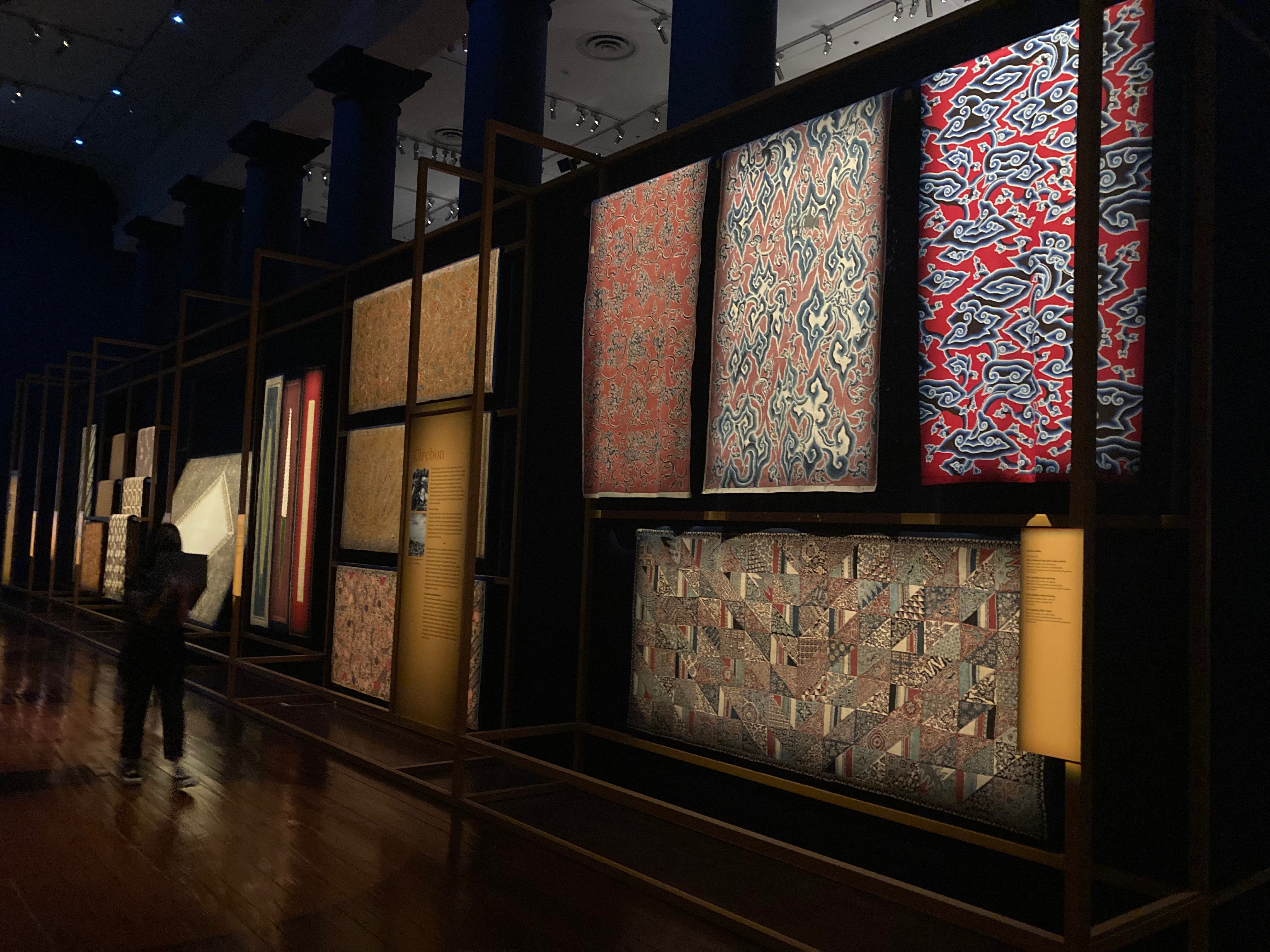
Coastal batiks / Pesisiran in 'Batik Kita' at ACM

'Batik Kita' at ACM with view on Batik from Cirebon


After a direct flight, I arrived in the early evening. The next day was my talk at the Asian Civilisations Museum (ACM) in Singapore. I went a little earlier so I could see the exhibition ‘Batik Kita’, were my talk ‘Demystifying Batik Belanda' was part of. After seeing briefly the wonderful museum, I headed toward the basement to give my talk. A little nervous at first, but so glad with all the familiar faces that turned up, I share some of the finding from my recent research ‘Re-telling the history of the (Indo-)European influence on Batik’. After my talk there was some time for questions, and there were so many, so great and diverse. Someone asked if I used a computer program to make my matches of batiks on wearers. If someone invented it, please let me know. But I had to explains it is just hours going through digitale databases. Someone asked about how to recognized if a Batik has been worn and many questions on how we should deal with other mistakes that might be in Batik literature. Very happy to meet the new generation that is ready to dive into this history too. 

'Kawan Kita' at Galeri Toko Kita with host Tony Sugiarta


On Sunday I was the guest at Galeri Toko Kita to talk among Batik friends in the Kawan Kita talk series organised by Oniatta Effendi & Tony Sugiarta by aNERDgallery. In the beautiful shop, which is a truly a love letter to Batik, I got to tell more behind the scenes/screens on my journey to Batik. We got so wrapped up in a discussion on Fake Batik and why we all love Batik, I didn’t even share all my slides. I also finally got to shop a Baju by Oniatta piece, my own pair of Utama pants. Which I wore right away to ACM again on Wednesday when I got to see ‘Batik Kita’ and the rest of the museum. 
It was great to have two such different presentations, and so wonderful that people came to both. Feeling like am welcomed by a new Batik family here, I feel so lucky and honoured. Thank you al for coming, supporting my journey and for loving Batik. As Oniatta says it perfectly: “Jauh Dikenang Dekat Disayang. Holding batik closer to our hearts.”


Showing my Batik relate Art works during 'Kawan Kita' at Galeri Toko Kita


After the weekend filled with talks, I was lucky to spend the other days meeting friends, being a tourist and trying out all local foods. Singapore is really amazing, all the colourful houses, had to photograph every single one. The murals in the Chinese neighborhood to explain its history. The Museums, just saw the National Gallery and ACM collection, but they are already so good. Cannot wait to return and visit the others. 
How lucky I am being guided around this interesting city ~ Monday started of with a visit to the National Gallery together with Tony. I went a little earlier and found myself in the rooms showing works from the collection in a decolonized space. First display I saw was on Batik and the influence Dutch colonial rule had on it. Next room had several paintings by Raden Saleh. Being eye to eye with the tigers that in the past were eye to eye with our royal family! Another stunning piece of horseman, made me think of a bamboo hat I got to see from the Tropenmuseum collection to write a blogpost for Modemuze. Wonder the hat in the collection can actually be a noblemen hat…


Painting 'Six Horsemen Chasing Deer' by Raden Saleh from 1860
At National Gallery Singapore

Raden Sarah's 'Boschbrand (Forest Fire)' from 1849
At National Gallery Singapore


The exhibition I had to see was on Aboriginal Art, ‘Ever Present: First people Art of Australia’. I knew it included Batiks from Batik Utopia, but it had also paintings and batik by Emily Kame Kngwarreye, such an inspiration (see previous blogpost 'London Baby'). A great show, a must visit if you can. It shows the development of Aboriginal Art in 4 spaces, from early acrylic painting to more political statement pieces. 
On Monday evening Eunice organised an amazing dinner to meet Batik friends with amazing Indian food.


Detail of Batik by Emily Kame Kngwarreye
in the exhibition ‘Ever Present: First people Art of Australia'
At National Gallery Singapore

Batik on cloth 'Mother and Child' by Chuah Then Teng, c. 1950s,
At National Gallery Singapore


Tuesday I got a tour of city by the perfect tourguide Eeling. We met in Utrecht, when I gave her and Eunice a tour. Was so happy we got to spend the day to explore the Chinese, Indian & Peranakan Chinese neighborhood and all the yummy food that goes with it. Saw so many houses I would love to live in, so colourful and stunning. 


Mural in Chinese neighbourhood
Writing a letter to Koen 
Photo by Eeling Koh

Colourful houses of Singapore


On Wednesday I could join the tour with Oniatta through Batik Kita with nice stories by our tourguide Hafiz Rashid. The exhibition is stunning. The batiks are displayed in full length, 3 above each other. It made it a little hard to see details on the pieces on top, but it was very nice how the different styles/areas/times were shown three pieces at a time. Next to the full batiks, there was much room for batik fashion. A section showed wearers from Singapore, from the flight attendance uniforms in the past, to nowadays well known batik wearers. The other ‘stages’ showed different designers, which included the Utama pants by Oniatta. So great to own & wear a piece that is on display! 
There is a catalog in the making, so keep you posted when it is out!

Next to Batik Kita, got invited to lunch by Jackie Yoong and she showed me the Fashion and Textiles space at ACM ~ A recently acquired 18th century English traditional dress made from painted cotton from India was the highlight in the room, next to sarong from three generations of the Nio family paired with kebaya ~  of which one was from the former Museum Nusantara collection. 
After lunch I walked around ACM again to see the Batik Besurek in the Islamic Art. I used this object in my talk since it is actually an imitation, most likely made in the Netherlands. It therefor is a real ‘Batik Belanda’ { > read/hear more about how Batik Belanda was the local name on Java for imitations from Europe in the 19th & 20th century in this story/YouTube video/instagram post}
We bumped into Chor Lin Lee, curator of Batik Kita at ACM, who was the one inviting me for the talk ~ happy I could finally meet Chor Lin in person, the author of the first Batik book I bought and cannot wait for the next one.

Thursday I got to meet textile collector, curator and writer Peter Lee. It is so amazing to meet so many people during this trip that I admired from afar for so long. Got to see some extraordinary pieces from Peter’s collection and an open invite to browse through more when I return to Singapore.  

Will return to Singapore for sure, still many people to meet & many to revisit. 
Thank you all for the warm welcome & looking forward seeing you online, 
in person or somewhere in the world!


Colourful house in Little India
in Singapore